Intro to brief and Initial Research
Winter Gardens:
The Domain Wintergardens were constructed following World War I with funds generated from the Industrial, Agricultural and Mining Exhibition of 1913-1914 (which was held at the same site).
“The Auckland Domain had been a public park since 1844 but was considered to be an area that was frequented by “undesirables”. The Wintergardens were considered to be part of the gentrification of the park, providing an attraction for people in the area during the winter months” hence the name. https://en.wikipedia.org/wiki/Domain_Wintergardens
Designed n the arts and craft style of Edwin Lutyens and Gertrude Jeckyll.


https://www.thecultureconcept.com/edwin-lutyens-and-gertrude-jekyll-design-for-living
The Domain Winter Gardens are a protected Heritage Site consisting of two display glass houses containing temperate plants and tropical plants, a formal courtyard with pond, and a fernery within an old quarry. Entry is free.
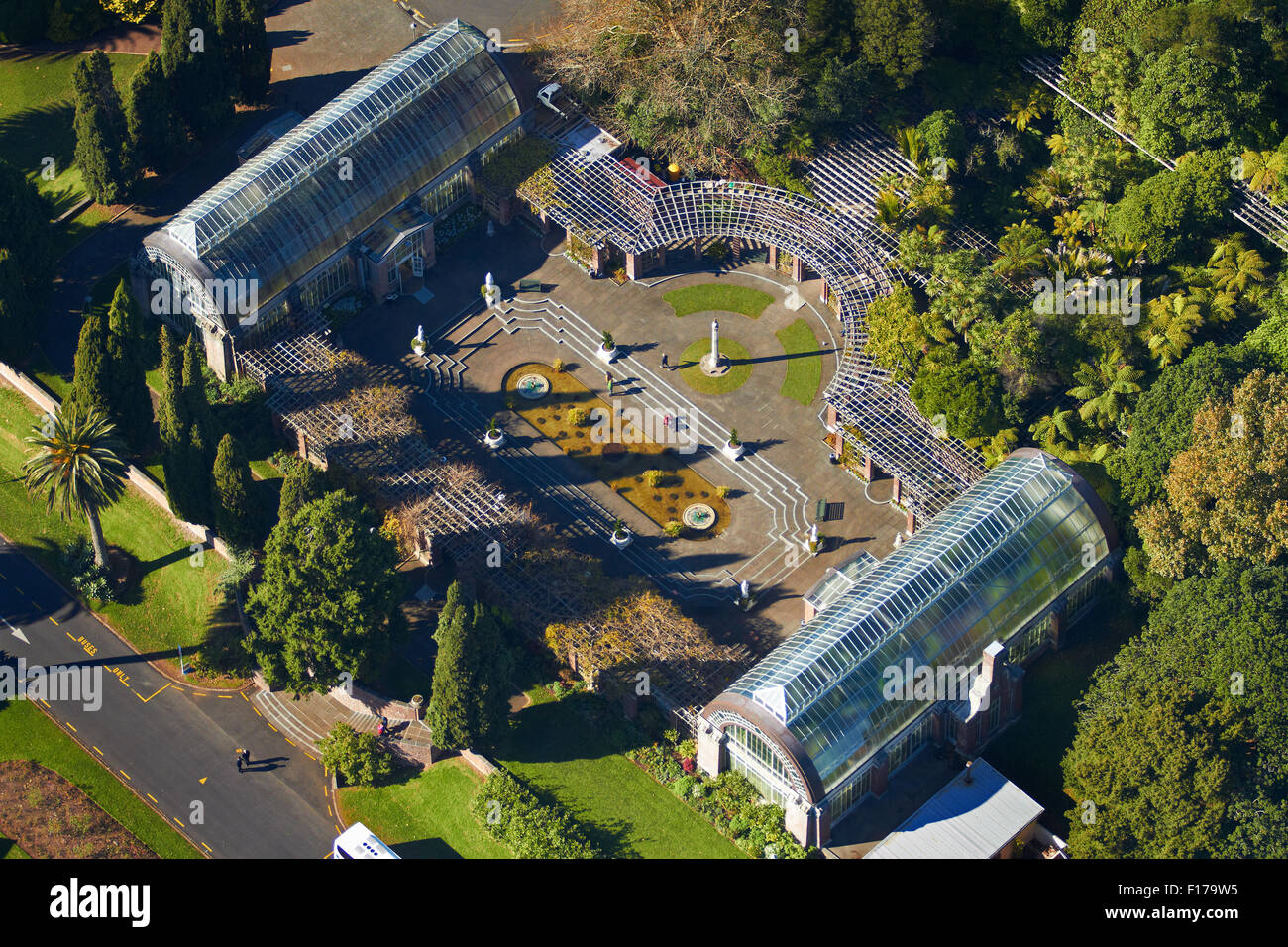
Wider context of the Domain:
Auckland Domain is one of Aucklands oldest parks and one of the largest. Developed on 75 hectares around the cone of an extinct volcano. The ‘tuff rings’ created by volcanic activity can be seen in the land contours and forms a natural amphitheatre.
The history of Auckland Domain / Pukekawa:
Auckland Domain/Pukekawa is the remnant of the ancient volcano Pukekawa. Its crater extends around the outside of the sport fields. The small volcanic hill is Pukekaroa, the site of a pa inhabited and fought over by many different iwi (tribes) throughout the early history of Tamaki Makaurau.
Governor Robert Fitzroy set aside the 75ha park in 1843, and since then it has gone through many changes.
During the Second World War it was used as a camp ground by American troops, and many exotic plants and birds were introduced by the Acclimatisation Society.
During the 1920s, the Wintergarden added Art Deco style and the Auckland War Memorial Museum became a permanent memorial to our fallen service men and women.
Still present in the Domain is a mighty totara tree, which represents the continued peace agreement between the Waikato tribes of Te Wherowhero, Ngati Whatua and Ngapuhi.
https://www.aucklandcouncil.govt.nz/parks-recreation/Pages/park-details.aspx?Location=126
Events:
Over the past 10 years there have been high teas held at the winter gardens, garden parties, music events and workshops.
Food Events:
In thinking about a potential food event at the domain winter gardens, it looks like the most common type of food event has been a high tea. There has been an entry fee for these kinds of events and they are tailored to women. Its very in step with the traditional architecture and history of the location. Quite sophisticated and upper class.
artist inspo/ research useful resources
Photos of the site:


Key words/ ideas from brief:
Synthetic world. In a greenhouse, the whole world fits together into a harmonious and controllable unity
The Gardens may be beautiful, welcoming, and historically significant, but they are also entangled with problematic ideas
and imaginations. Auckland was already a place of gardens: the various kainga (settlements) of Tamaki
Makaurau were surrounded by extensive plantations and constructed landscapes. The concept of nature that
arrived with Pākeha settlers is distinctly different from the Māori idea of whenua. How might the culturally specific ideas behind the Winter Gardens converse with indigenous thinking?
– Maori are a people that partner with the land for mutual benefit and gain. European thinking has always been about claiming, dominating and controlling land.
What kind of public space do the Winter Gardens offer?
They offer an attraction for people in the area, a shared garden or natural space to enjoy when wanting to step away from the busyness of the surrounding city.
What public (or publics) does they support?
When the gardens where originally built they served the working class by providing an attraction in the winter months but also served the wealthy as the implementation of the gardens made the area more attractive, inviting wealthy people to move into the area. I would say that this is still the case in 2021. The gardens are another feature of Auckland city making it an attractive place to live and work which brings more working class people into the area as well as wealthy business people generating more income for the city.
Who do they speak to, serve, or exclude? Whose story do they tell?
The gardens speak to the origins of settlers in New Zealand and the early days of our western society. It serves colonial ideology in the domination of a space and excludes the indigenous Maori history, practices and care of the land.
And more importantly, looking ahead, what kind of public space could they offer?
What public (or publics) could they support?
Who could they speak to, serve, or include? What other stories remain to be told?
Drawing on the idea that this is a synthetic world. A world that has been carefully curated to tell a certain story, the space could be used to extrapolate that idea and create an alternate version on reality. A space that feels familiar but upon closer inspection is alien. You could play with the idea of ‘What if?’ and explore that in a context that includes traditional European thinking and Maori History and culture. A parallel universe.
FOOD EVENT DESIGN
The Wintergardens often hosts events. You’re challenged to imagine a food-based event:
something as small as a picnic, or something as large as a food festival. It might be a highly formal, staged event, or something more casual. Events are designed to be installed and deinstalled quickly, leaving no permanent trace. Think about creating maximum spatial effect using temporary elements. We will need to workshop aspects like lighting design, furniture, textiles; and temporal planning of the event (what will happen, why is it relevant to the Wintergardens, how long will it take, who will be involved, how will they be choreographed?)
Examples of Events in Gardens:
Weddings:

Picnics:

Lawn Mowed Into Checkerboard Becomes Natural Social Distancing Space

Amsterdam Restaurant To Serve Guests in Individual Glass Greenhouses
Auckland Food Events:
Auckland Lantern Festival
Auckland Vegan Food Festival
Silo Park Movie Nights
Food truck collective https://foodtruckcollective.co.nz/
Hamilton gardens:
Gourmet in the gardens every Sunday in March. https://hamiltongardens.co.nz/events/gourmet-in-the-gardens-2020-2021/?sd=2021-03-01
European gardens?
Events Inspo:
Burning man – alternate reality
Coachella – Super creative and art focused
Glastonbury
Tomorrowland
Woodstock
Designers:
Joseph Paxton – English landscape gardener and designer of hothouses, who was the architect of the Crystal Palace for the Great Exhibition of 1851 in London.
He was originally a gardener employed by the duke of Devonshire. From 1826 he was superintendent of the gardens at Chatsworth, the duke’s Derbyshire estate; he built in iron and glass the famous conservatory there (1840) and the lily house for the duke’s rare Victoria regia (1850). Also in 1850, after a cumbersome design had been officially accepted by the Great Exhibition’s organizers, Paxton’s inspired plan for a building of prefabricated elements of sheet glass and iron was substituted. His design, based on his earlier glass structures, and the grandeur of its conception was a challenge to mid-19th-century technology. Although it was built within six months it was not until later that the structure was seen as a revolution in style. – https://www.britannica.com/biography/Joseph-Paxton
Joseph Paxton was the key influence in the success of the green house. His time at Chatsworth allowed him to excel in his practise.
Significant projects –
- Crystal palace https://www.britannica.com/topic/Crystal-Palace-building-London – It could be considered one of the first theme parks.
- Chatsworth Glasshouse – this was the structure that caught the attention of the Queen. Its size and grandeur left everyone mesmerised. A designer has re created the glasshouse in virtual reality – https://www.prolificnorth.co.uk/digital/featured/2017/06/chatsworth-glasshouse-recreated-virtual-reality
- Chatsworth Conservatory Wall – was built in 1842 with an ingenious system of flues and hot water pipes to protect climbers. – https://www.chatsworth.org/garden/history-of-the-garden/6th-duke-paxton/the-case/
THE CONSERVATORY, CRYSTAL PALACES AND THE CLIMATE REVOLUTION – A great article tracking the time line of the creation and use of glass, the development of discovering and sourcing exotic plants, the need and innovation of a space to let the exotic plants thrive on foreign ground, the power dynamics at play with the possession of exotic plants, https://www.thecultureconcept.com/the-conservatory-crystal-palaces-and-the-climate-revolution
Marije Vogelzang – Marije Vogelzang is a Dutch “food”, or “eating”, designer who focuses on how people design their food habits, ways and rituals. She regularly works as a designer for organisations and a food industry consultant.
“My real interest in food started at the Design Academy Eindhoven where I started to understand how food has such a powerful emotional influence and how it can be used in rituals. I remember that as a child I was a bit bored by the food and bland flavours of Dutch cooking. Traveling to me meant getting in touch with new flavour experiences and understanding culture trough the tongue.” https://marijevogelzang.nl/about-us/
Significant Projects –
- Volumes – ‘The project Volumes is an attempt to influence our eating behaviour and our eating culture. We have the tendency to overeat and are visually mislead by large plates and wide glasses. By adding volumes to your plate your brain will register more food than there actually is. Your stomach can’t count. Your brain will tell your stomach it had enough.’ – https://marijevogelzang.nl/portfolio_page/volumes/
- Faked Meat – ‘The world population is growing fast and we can’t maintain the way we are eating meat in the future anymore. In the west there is a big development going on with vegetarian substitutes (protein based products (soy) that look and taste like meat). What I don’t understand is that the meat substitutes always look like real meat.’ – https://marijevogelzang.nl/portfolio_page/faked-meat/
- Sharing Dinner – ‘I decided to create a simple “intervention.” I used a table with a tablecloth, but instead of putting the cloth on the table, I made slits in it and suspended it in the air, so that the participants sat with their heads inside the space and their bodies outside. This physically connects each person: If I pull on the cloth here, you can feel it there.’ – https://marijevogelzang.nl/portfolio_page/sharing-dinner/
Wednesday:
Site Analysis:
The domain sits on the volcano Pukekawa, hill of bitter memories, and refers to tribal battles fought on the site until 1828 between Hongi Hika (leading Ngāpuhi from the North) and Pōtatau Te Wherowhero (leading the local Ngāti Whātua).
quantitative and qualitative contexts
- A public park in the middle of a big busy city
- Has colonial history from the settlers developing the city
- Has indigenous history from tribes that had settled on the hill before the settlers came.
- Is a shared space maintained by the council.
- Is on elevated ground.
- Well groomed
- A tourist attraction
- Auckland domain spans 75 hectares
- Is Aucklands oldest park.
- Created in 1843 when the land was bought off Ngati Whatua
Why was the site chosen to build on:
The site for the Domain Winter-gardens was chosen to build on to commemorate the Auckland Industrial, Agricultural and Mining Exhibition 1913-14.
Cat statue:
“The original plans for the courtyard area were drawn up by architects Gummer and Ford, and there was to have been a bear at the top of the pillar instead of a cat.
However, one of the decision-makers (it may have been William Gummer himself) was an anti-socialist and thought that, as a bear symbolised Russia and therefore socialism, he would change the statue to a cat.
A story in the Auckland Star of February 4, 1976, provides the second version. Sybil Dibble told the paper the statue was the King of the Cats.
“With his upstretched paw he is appealing to the King of the Birds to stop the incessant war between cats and birds.” – https://www.nzherald.co.nz/nz/ask-phoebe-cat-statue-two-tales/H75UBF6FXODWLJINTYO5FXYVBE/
Origin of the statues:
The statutory was added in 1920-30s by local business man William Elliot.
Who designed the statuary what does it represent?
Meanings of plants – any interesting parallels?
Readings:
Read the transparency paper
Research and then ask the next question. Become more particular.
Food:
Marije Vogelzang Food Artist – i really like grazing city scapes, feed love tokyo, connection dinner
What is the setting? picnic, formal dinner, mingling, big small,
What is the food? culture, how its eatin, how its displayed
Social context? covid, germs, sharing, history, culture
How do people eat in different spaces, cultures? pace, company, setting
Cultural holidays?
Before Monday:
Identify five keywords that highlight particular areas of interest for you related to your research on the site and its social and historical contexts.
- Zoo – a collection of exotic things to be admired
- Sanctuary – a place to escape, to experience something out of the normal
- Synthetic – An unnatural environment created to showcase nature
- Orderly – The winter gardens design is very organised and symmetrical lends itself to the theme of control
- Beautiful – there is magical beauty about the gardens
Share some visual representations of the site that you have produced (you can use a wide range of media to do this:

A page of my initial musings towards the site. Noting shapes, patterns, textures.
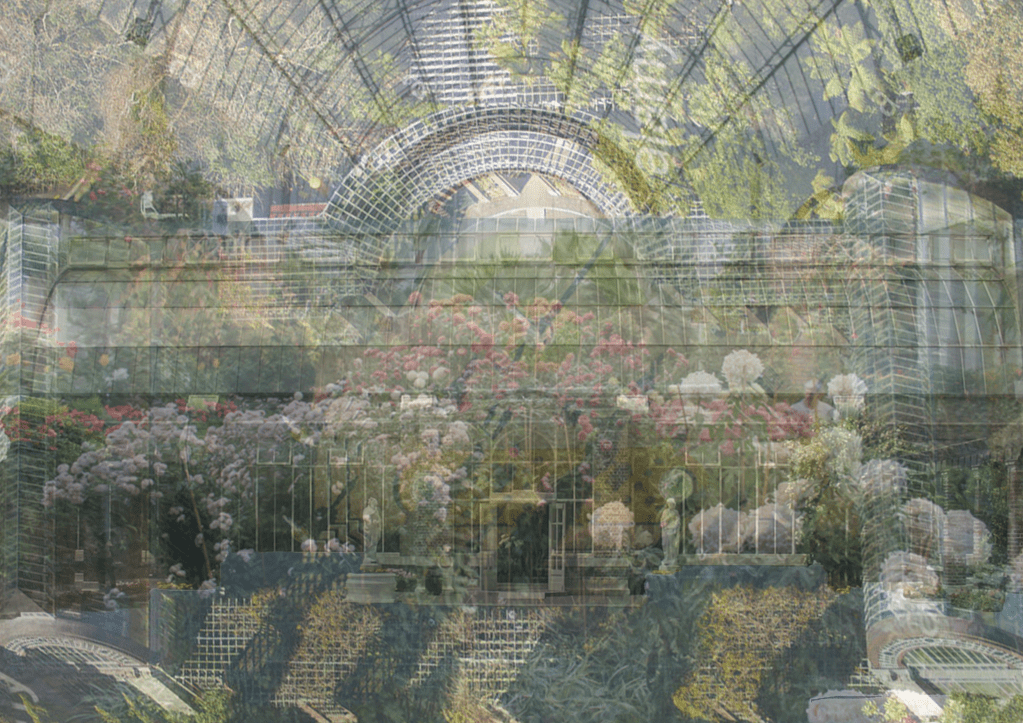
With this layering of images I wanted to identify the symmetries of the site in a wider context.
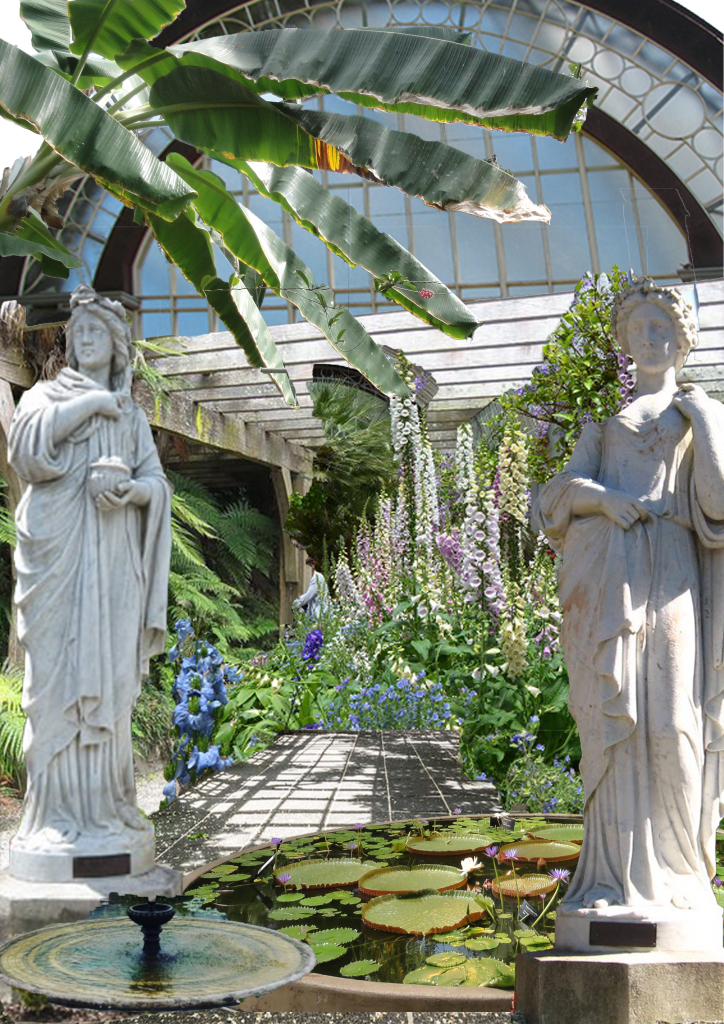
With this collage I was exploring the repeating motifs that occur throughout the site. Circles, grid lines, symmetry, order, chaos, boundaries, the partnership between man made and the wild.
 Spatial Fabrication