Monday
Script talk
- pre script
- the script
- post script
Designer inspo:
- lacaton vassal
- Sophie Calle
- Parc de la Villette Tschimi
Temporal span – I’m interested in the period of time when the day comes to an end and the night begins. To watch the transition in the atmosphere, how that changes how we interact with the world and the changes we undertake in that transitional period.
Site within a site I intend to work with – the balcony on the front of the Roxy club. Playing with the idea of entertainment coming from the windows. Nodding to roxys time of being a cinema and providing entertainment then. Im thinking of creating more balconys/ landings/ viewing platforms on the car park side to sit and watch the windows of the buildings.
5 key conceptual terms i’m working with:
- reality entertainment – i personally love to people watch and i think everyone else does too which is why reality tv shows are such a hit. There’s something incredibly satisfying about being a fly on the wall in. However in these reality tv shows there is a level of control surrounding the narrative that gets communicated which could be fun to explore.
- privacy – You can easily induce the feeling of privacy using the right lighting, arranging a space in a certain way and channelling people’s attention. Windows are an interesting element when exploring privacy. They allow people to look out from a controlled vantage point on unsuspecting subjects but also lets people look into an intimate environment especially at night when lights are on inside leaving the inside people none the wiser.
- public – What does it mean for something to be public. How do we differentiate between a public encounter vs a private one? Does a public encounter just mean we’re allowed to see it or that it has been made for the viewer to see? If that’s the case most interactions we observe wouldn’t be for the public.
- Control – i like the idea that you can control the narrative of what people see depending on how you frame a situation or environment. Things look a lot different through a small window especially if what’s in that small window is carefully curated for a certain story or narrative. Our imaginations can do us dirty when we have room for filling in the blanks.
- Perception – similar to control, the way we perceive our environment is influenced by things like lighting, composition of forms, textures, sounds, smells. These influences can leave us with a very distinct impression weather we mean them to or not and ultimately affects how we have experienced a place. Its our instincts overriding our logic.
Idea:
a mirror ‘screen’ on the ground set at such an angle to watch a certain balcony or spot above the lane. “watching a show”, ‘reality tv’. Mirror or reflective surface? rose tinted?
Actively sitting down to watch reality. A stage and a grand stand?
An event? half get invited to get ready and go to a night out, half get invited to watch people live their life?
Tuesday:
Develop Temporal Vocab – min 3 terms define briefly
- Transitioning – moving from one space to the next, or from moment to moment. The pause in the busy where we close a chapter and open a new one.
- Periodically – having a program at regularly occurring intervals over a course of time.
- Beginning – the official start to something new. In my opinion the beginning is the most exciting moment of any period of time.
- Ending – The official close of a period of time. A clear marker to communicate that what has been taking place will no longer continue the way that it has.
- Pace – the tempo or rhythm at which we move through time and take in information.
Invent series of 5 drawings that describe design idea moments, rough manner, thinking about fragments or moments:
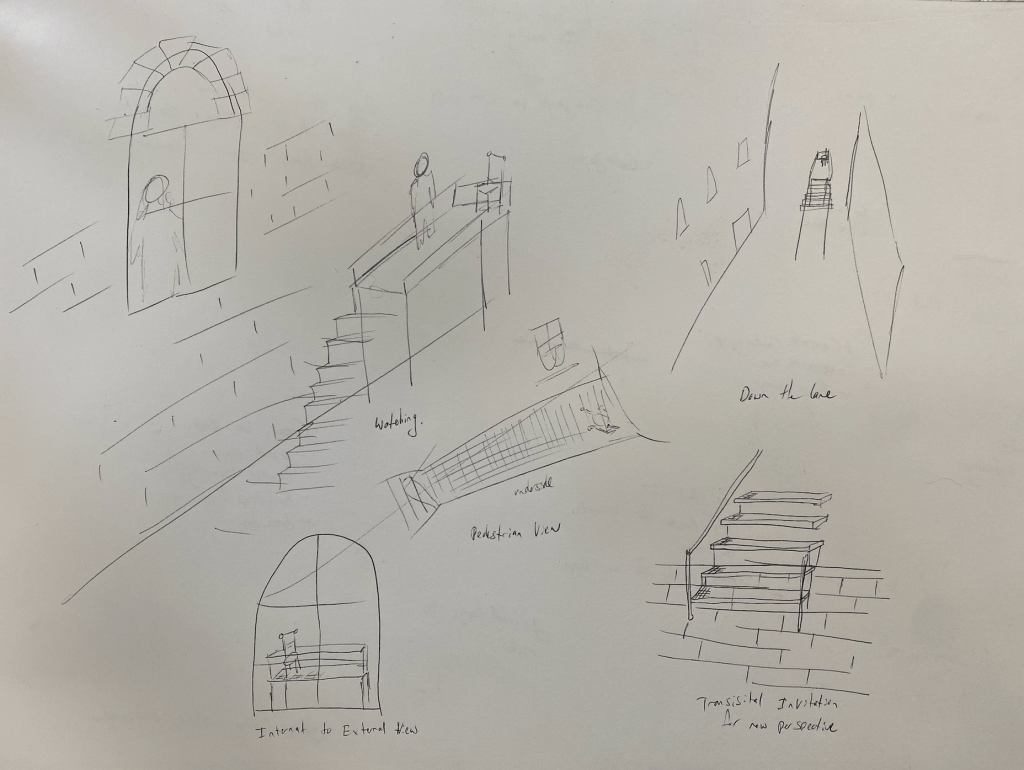
Write draft script (programe) for design intervention.
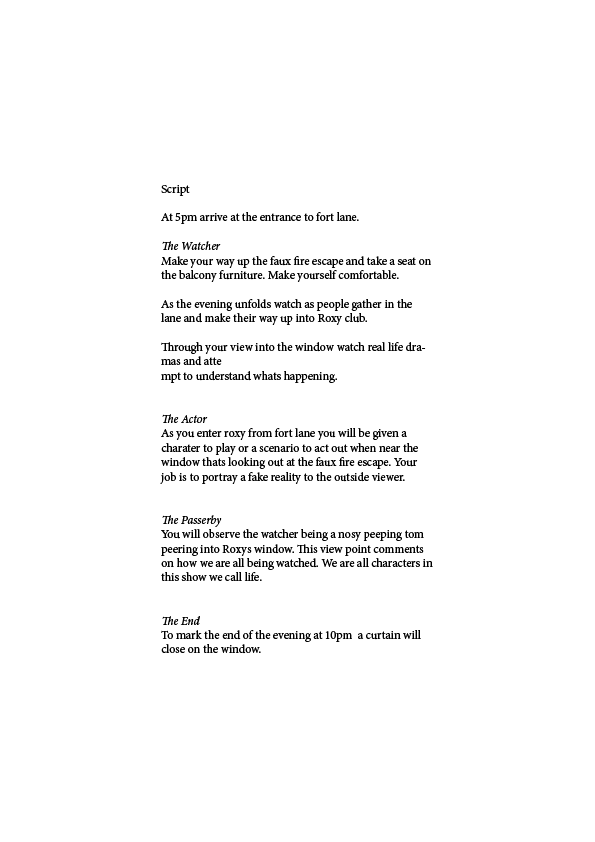
Annotate drawings:
what will take place? potential scenarios to take place.
The kinds of situations people love to poke their noses into – an affair, young love, a fight, a theft.
Who is it for? 18 years old and up. people who enjoy people watching, drama, reality tv.
How many times/ how often? Every friday night for a month.
Why is it important to me? I think its important to remember that we don’t always know whats going on behind the scenes in peoples lives. What you see of someones life through things like social media or from a short period of time with them isn’t the full story. Theres always more than meets the eye.
Wednesday:
On site with script:
Take detailed measurements, pics rubbings etc. materiality community context action, gesture, tonality, shadow. Develop considered design concept/intervention.
idea: balcony tea? the future of urban socialising. being neighbourly, living in community.
Inspo:
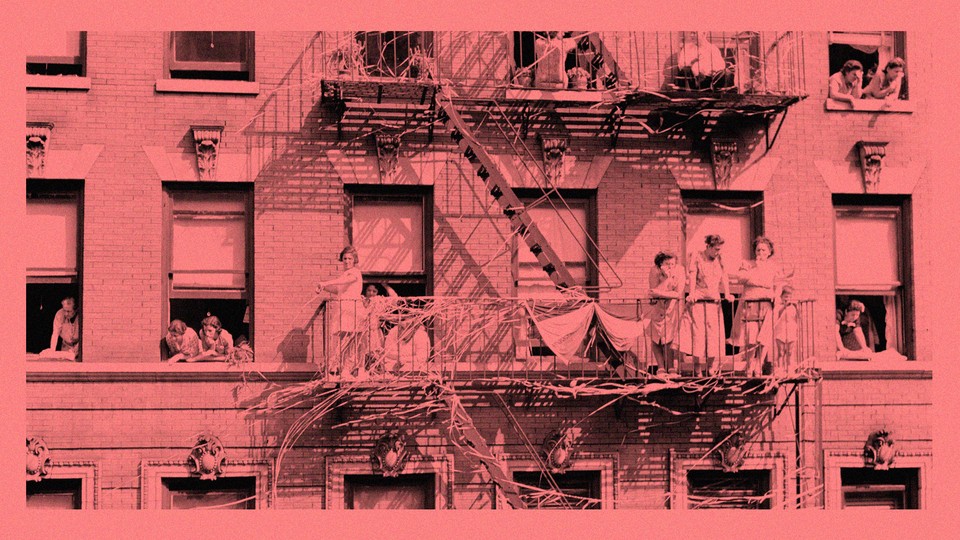
‘City dwellers reshaped the fire escape, and in so doing it changed urban life. Fire escapes became makeshift jungle gyms for kids and offered a place to catch a breeze while hanging the wash to dry. Today it’s uncommon to hear of people dying after rolling off of a fire escape in their sleep, but it’s normal (if still illegal) to see fire escapes turned into vegetable gardens, smoking patios, and makeshift bike racks.’
‘Most fire escapes have the sharp edges of utilitarian simplicity, but many are ornate works of decorative art designed to be functional jewelry, albeit for urban infrastructure.’


‘In 1942, the American painter Edward Hopper produced the signature image of urban loneliness. Nighthawks shows four people in a diner at night, cut off from the street outside by a curving glass window: a disquieting scene of disconnection and estrangement. In his art, Hopper was centrally concerned with how humans were handling the environment of the electric city: the way it crowded people together while enclosing them in increasingly small and exposing cells. His paintings establish an architecture of loneliness, reproducing the confining units of office blocks and studio apartments, in which unwitting exhibitionists reveal their private lives in cinematic stills, framed by panes of glass.’
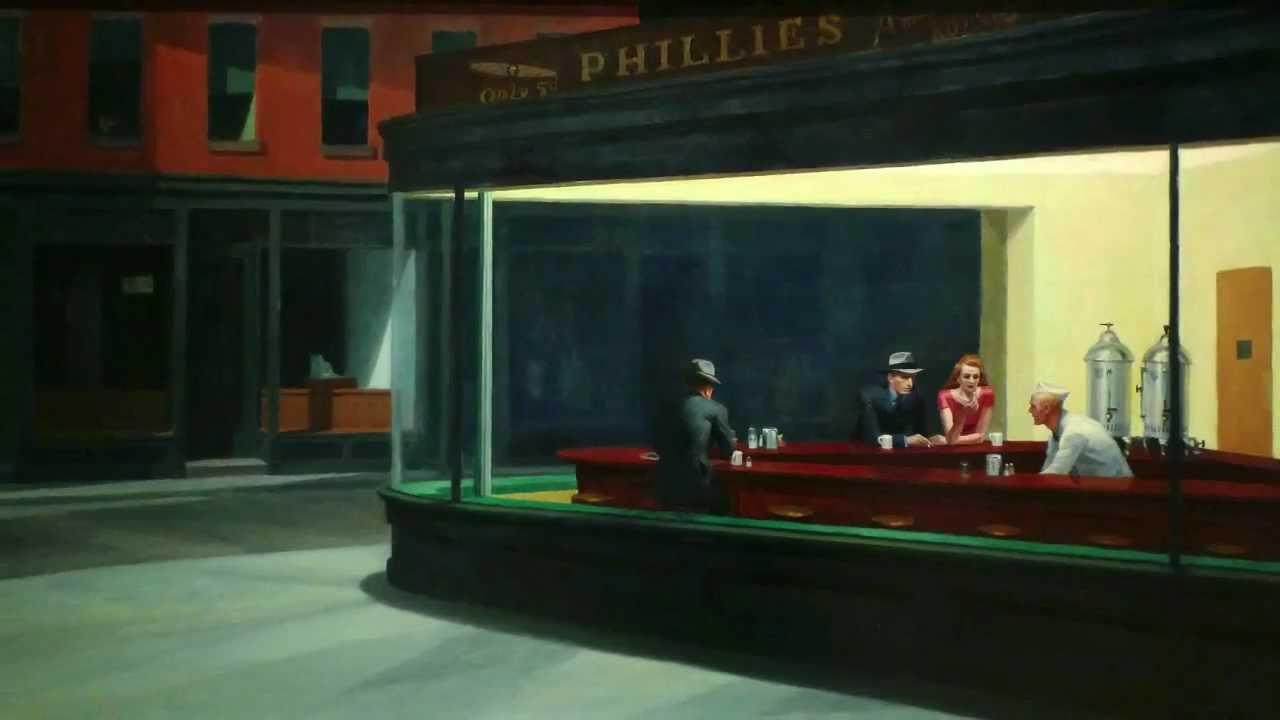
‘The dissolution of the barrier between the public and the private, the sense of being surveilled and judged, extends far beyond human observers. We are also being watched by the very devices on which we make our broadcasts. As the artist and geographer Trevor Paglen recently said in the art magazine Frieze: “We are at the point (actually, probably long past) where the majority of the world’s images are made by machines for machines.” In this environment of enforced transparency, the equivalent of the Nighthawks diner, almost everything we do, from shopping in a supermarket to posting a photograph on Facebook, is mapped, and the gathered data used to predict, monetise, encourage or inhibit our future actions.’
https://www.theguardian.com/society/2015/apr/01/future-of-loneliness-internet-isolation
Artist research:
Atelier bow wowLinz Super branch – inspo for my faux fire escape.


https://www.scandinavian-architects.com/en/atelier-bow-wow-tokyo/project/linz-super-branch
Alternative structures for an elevated platform. Considering material, colour, finish and how it feels to touch as well as structural details and the way it relates to its surrounding structures.
Thinking of event space/ performance space:
how you can utilise non traditional sites, materials and building methods to create a space to host entertainment.

Starting with the idea that how spaces are imagined is often as important as their physical characteristics in determining their use, the Folly reclaimed the future of the site by re-imagining its past. The new ‘fairy tale’ for the site described the Folly as the home of a stubborn landlord who refused to move to make way for the motorway, which was subsequently built around him, leaving him with his pitched roof stuck between the East and Westbound lanes.
https://assemblestudio.co.uk/projects/folly-for-a-flyover
Critically thinking about how I create my faux fire escape structure to bring intrigue and spatial experience to my intervention:
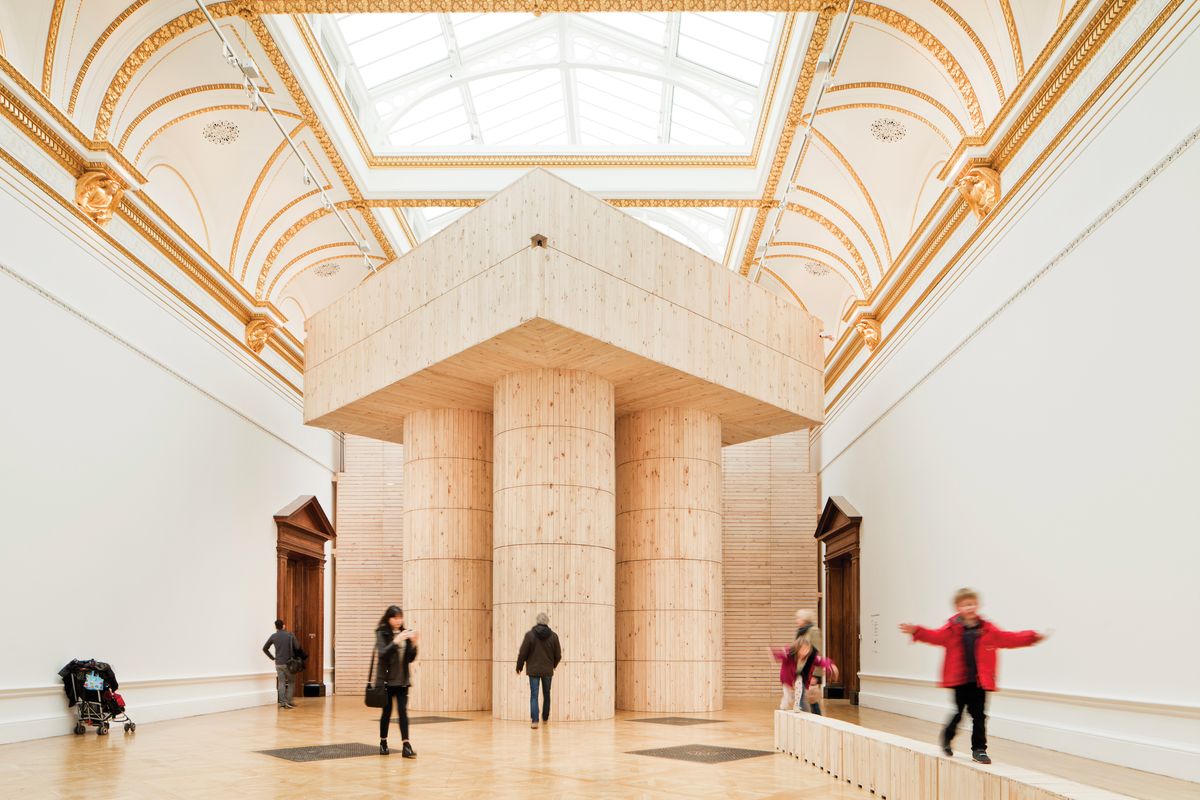

‘The task of representing something that – even at its most sculptural – resists being reduced to an object is a formidable one.’
 Spatial Fabrication