Examples of work:
https://surfacecritiqued.wordpress.com/
https://rubymelhuishspatialstudio.tumblr.com/
https://urbanlaneway.wordpress.com/2018/10/29/final-design-presentation-model-booklet/
https://foretst.wordpress.com/
https://jgdesignstudioiii.tumblr.com/
https://www.tumblr.com/blog/view/jay6332
Formative Feedback:
Who are the neighbors, and how are they being nosey? Answer these questions through the experience of your design. What will encourage viewers to snoop around your chosen site, and what will they see if they engage with your work?
There is a lot of potential to explore your concepts in a dramatic and narratively satisfying way. Dive into the script/program for your proposal and give us some concrete landing points. This could be found in one or two specific details, that lead to the rest of the project being resolved. Start with one specific detail, view, or moment that sums up your intended affect. You are responding to both the brief and the site in a sensitive and considered way.
Artist research:
Gordon Matta-Clark
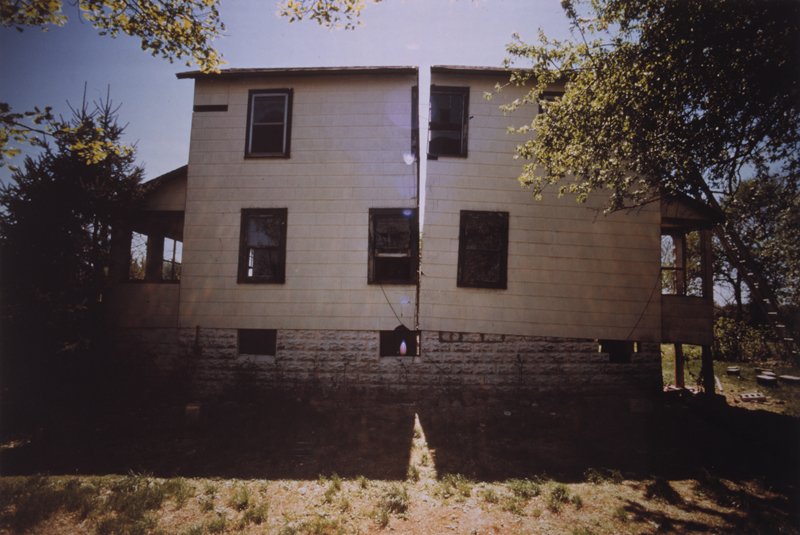
‘Anarchitecture – a combination of ‘anarchy’ and ‘architecture’
Whatever its origin, the term Anarchitecture, expressing as it does a creative tension between Apollonian and Dionysian opposites, has come to summarise many of the concerns explored by Matta-Clark during his brief career.’
‘The first object he suggests for inclusion is a plain board with the words ‘NOTHING WORKS’ written on it. This fundamentally anti-functional statement, described in his letter as ‘a reaction to the prime-crime axium of modern design-fighters’, stands in direct opposition to the whole ethos of utilitarian modernism.’
‘In a footnote, Louis Sullivan’s dictum ‘form follows function’ is manipulated through the distorting mirror of the artist’s compulsive punning to become ‘form fallows function’. If this wordplay means anything it implies that a rigid adherence to certain ideas of form will restrict an object or a building’s usefulness. An opposite approach might be to allow an object’s appearance to suggest spontaneous new uses, in the way that the carriage of a wrecked train suddenly becomes a bridge in the photograph included in the Anarchitecture show.’
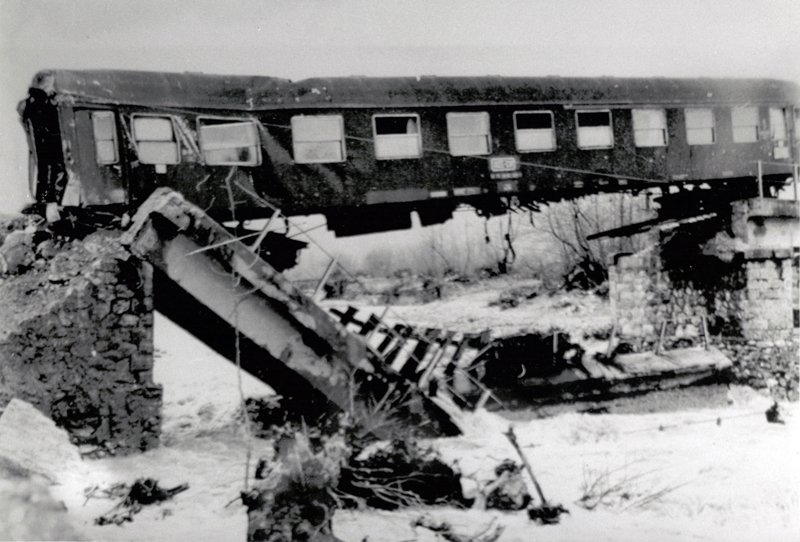
‘and speaking of the importance that living in an apartment and meeting neighbours from his window high above the ground had had on his artistic development.’
‘Aware as he must have been of the street-drama of the construction and demolition going on around him, motifs that came to play a part in his own practice,15 Matta-Clark would have been equally aware of the argument raging in the neighbourhood in which he lived.’
proposing that more could be learned by closely observing the urban environment as it was than imposing grand plans upon it.
A RESPONSE TO COSMETIC DESIGN
COMPLETION THROUGH REMOVAL
COMPLETION THROUGH COLLAPSE
COMPLETION THROUGH EMPTINESS
Anarchitecture celebrated the inner city in all its disorder and variety and crazy juxtaposition of eras and styles
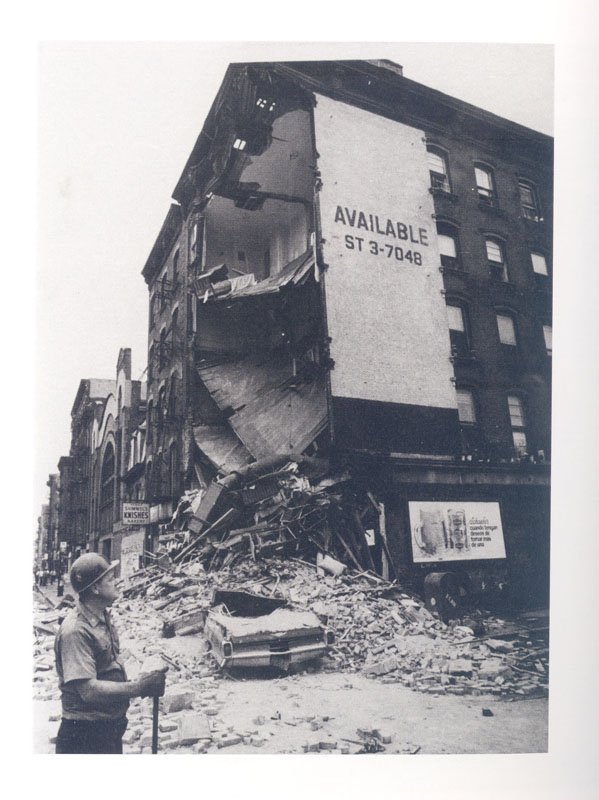
He had long been fascinated by glimpses of the interiors of buildings, whether seen through a window or through the work of the wrecking-ball, as in the series of photographs he took of the exposed walls of semi-demolished buildings that became Wallspaper 1972
he was really very much interested in this idea that the city had a life which was in the air, it had a life which is on the ground and it had a life below the ground
Slicing up and re-building these apartments, both for himself and for others as a way to earn a little cash, was one of the ways Matta-Clark developed his ideas about the sculptural use of space. As he put it, ‘one of my favourite definitions of the difference between architecture and sculpture is whether there is plumbing’.
Matta-Clark himself was more interested, as he put it in his notebooks, in converting a building into a state of mind
Anarchitecture was, as he wrote on an art card, ‘about making space without building it’
Article 2:
Calling the ancient ruins of Europe benign because they have been ‘swept clean’ – preserved too conscientiously, perhaps – Matta-Clark goes on to propose non-u-ments to be the most provocative relics. The following year, in a letter to artist and dancer Carol Goodden, he expanded on his idea of the non-u-ment: ‘1) it is just as good at any size 2) it is totally unfit for people 3) it invites the visitor to move away’.5
Their installation against the walls of 112 Greene Street – a building that was also ruined, but given new purpose as an exhibition space – doubly underscores how places ‘unfit for people’ can be re-imagined under the right circumstances.
a space of memory rather than history
In Matta-Clark’s words, Fake Estates was intended to comment on ‘spaces that wouldn’t be seen and certainly not occupied. Buying them was my own take on the strangeness of property demarcation lines. Property is so all-pervasive. Everyone’s notion of ownership is completely determined by the use factor.’8 Matta-Clark’s attention to these spaces – a stretch along a gutter, or the matted grass that complements a concrete driveway – reimagines the private-public relationship with space, questioning the way that society values space based on use-value and ownership, and even challenging the concept of private property.
We were thinking more about metaphoric voids, gaps, leftover spaces, places that were not developed … for example, the places where you stop to tie your shoelaces, places that are just interruptions in your daily movements. These places are also perceptually significant because they make reference to movement space
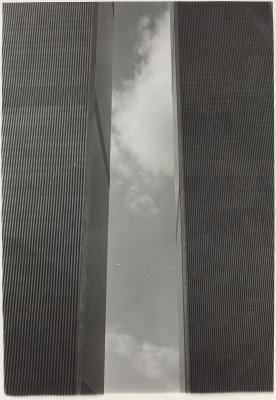
he was actively repurposing the grand ruins of a previous economic structure as a site for the ritual of artistic practice. It is ironic, therefore, that through the refurbishing of previously forgotten spaces, the lofts of Soho became economically valuable again, and the real estate developers eventually came to claim them
Matta-Clark’s work – coming at the intersection between architecture, installation, sculpture, performance, film, photography and cuisine
Walls Paper in particular exposes the shifting terrain of cities, delicately articulating the tension between architecture and ruin, and intervening in the space between the shiny spectacle of capital and its eventual, inevitable decay.
https://www.tate.org.uk/research/publications/in-focus/walls-paper/ruins-and-non-u-ments
Matta-Clark’s ‘Fake Estates’ (1973)
“They were a group of fifteen micro-parcels of land in Queens, left-over properties from an architect’s drawing. One or two of the prize ones were a foot strip down somebody’s driveway and a foot of sidewalk. And the others were curbstone and gutter space. What I basically wanted to do was to designate spaces that wouldn’t be seen and certainly not occupied.”
‘As an architect, what has long fascinated me about the Fake Estates was the unbuildabuility of the parcels—that is, their inability to receive a building in the traditional sense. Matta-Clark is suggesting rhetorically that a site could be something else than a piece of land to receive a building. Furthermore, I was fascinated with the idea that an act of documentation could constitute an end result in itself.’
https://martinhogue.net/Fake-Fake-Estates-Reconsidering-Gordon-Matta-Clark-s-Fake-Estates
Arnold Van Gennep ‘Rites of Passage’.
“liminal” phase, in which individuals are neither in their former group or position nor yet re-introduced into society, is very significant.
During this time, each individual prepares him or herself for the future, and the responsibilities that will come, yet during that time they are not constrained. Thus, barriers that might normally exist between people of different social status, for example, dissolve and each person is regarded as simply another person in the same liminal state.
During the liminal stage, normally accepted differences between the participants, such as social class, are often de-emphasized or ignored. A social structure of communitas forms: One based on common humanity and equality rather than recognized hierarchy. For example, during a pilgrimage, members of an upper class and members of a lower class might mix and talk as equals, when in normal life they would likely never talk at all or their conversation might be limited to giving orders
https://www.newworldencyclopedia.org/entry/rite_of_passage
Do-Ho Suh
He also works across various media, including paintings and film which explores the concept of space and home. His work is particularly well known in relation to anti-monumentalism. His works convey his life experiences, including the homes he has lived in and the diversity of the people he has met.

https://www.tate.org.uk/art/artists/do-ho-suh-12799
contemporary artist renowned for his ethereal one-to-one-scale fabric replicas of former residences and domestic settings that have notions of memory, displacement, and home embedded into their permeable and translucent surfaces.
https://ocula.com/artists/do-ho-suh/
-memory, public and private space, and also practical systems of hanging/displaying your design.
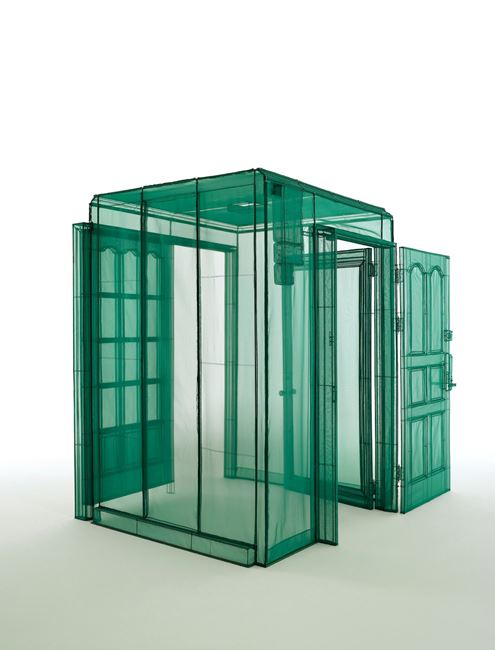
Hub-1, Entrance, 296-8, Sungbook-Dong, Sungboo-Ku, Seoul, Korea, 2018 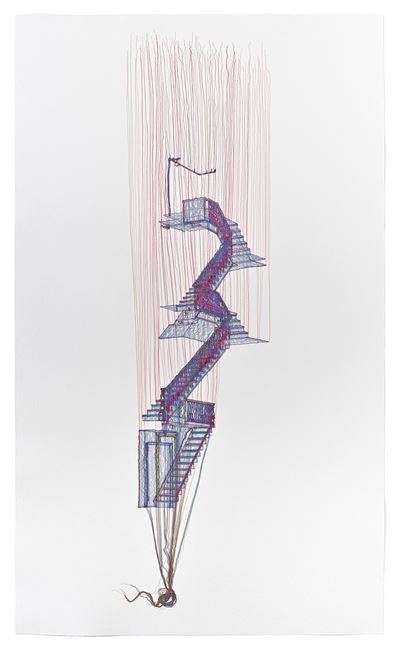
Staircase/s, 2019 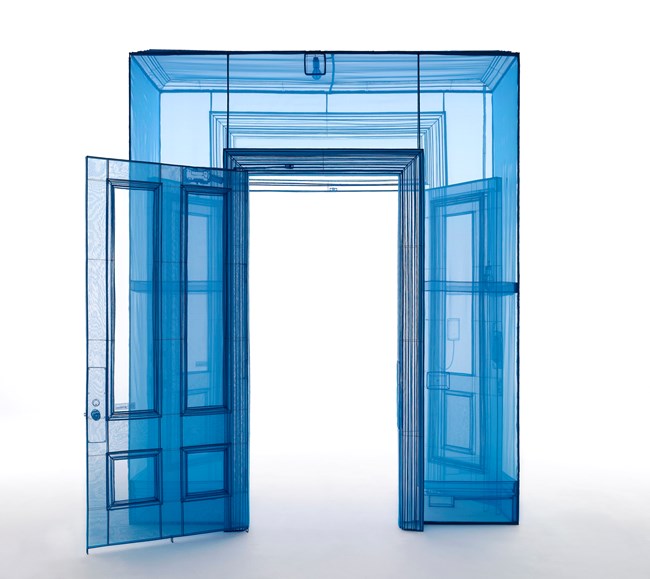
Main Entrance, 388 Benefit Street, Providence, RI 02903, USA, 2016 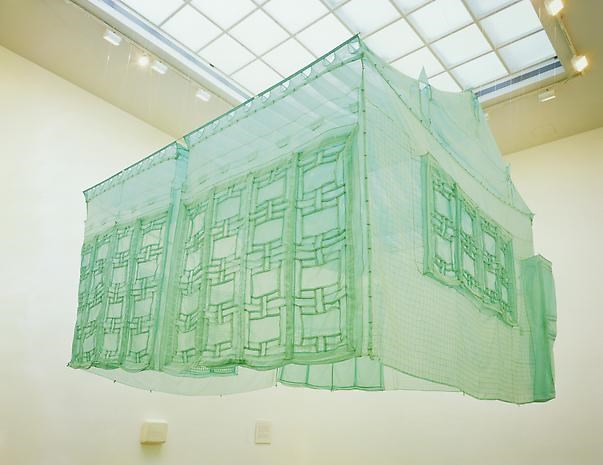
Seoul Home/L.A. Home/New York Home/Baltimore Home/London Home/Seattle Home/L.A. Home, 1999 
Reflection, 2004 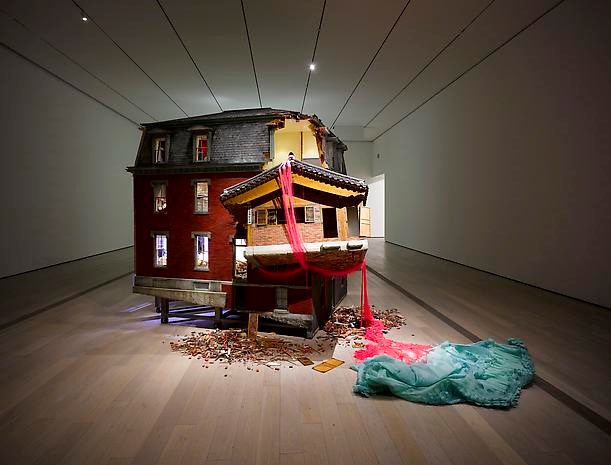
Fallen Star 1/5, 2008-2011
https://mymodernmet.com/do-ho-suh-home-within-home/
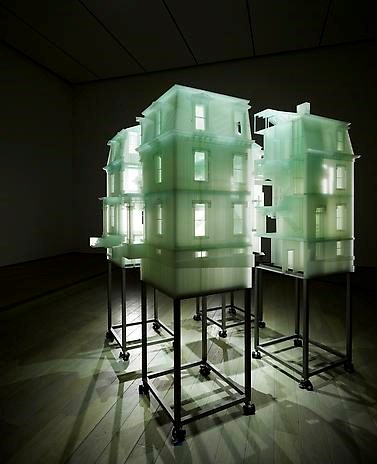
Home Within Home – Prototype, 2009-2011 
Blueprint, 2010
Hangong work –Home within Home, 2019

‘Walking in Trees’ (2019) by AUT’s Richard Orjis
Very ‘Swiss family Robinson’ vibes. I like the use of levels and how the structure moves people through the tree.
“Walking in Trees”, an outdoor art project connecting urban dwellers with the natural world around them.

https://melanierogergallery.com/news/2019/richard-orjis-walking-trees
Chris’s note – he work considers similar concepts to yours – publics, the urban, and viewership. It also reminded me of your work in terms of aesthetics, with the industrial/constructional scaffold appearance.
Orjis’ work allows us to change how we view our urban ecology, and reconnect with the natural world in an intimate way, how does your work allow us to view something differently? Through what means?
ask yourself what history or narrative does your work allow us to view?
Key ideas/ themes from research that i want to take further:
‘a rigid adherence to certain ideas of form will restrict an object or a building’s usefulness.’ Think outside the box. See the potential an object or space could have outside of what we are told it should be or what service it should provide. Be abstract/ fantastical with its purpose.
What could be learned by closely observing the urban environment as it is?
crazy juxtaposition of eras and styles in the urban environment.
glimpses of the interiors of buildings through windows or holes on the wall.
‘difference between architecture and sculpture is whether there is plumbing’.
Changing a building into a state of mind.
a space of memory rather than history
liminal phase
Think more abstract when thinking about materiality. Transparency?
Transitional spaces – stairs, entrances, corridors
i like the aestheic of scaffolding, the support structure that sits underneath the main space.
 Spatial Fabrication