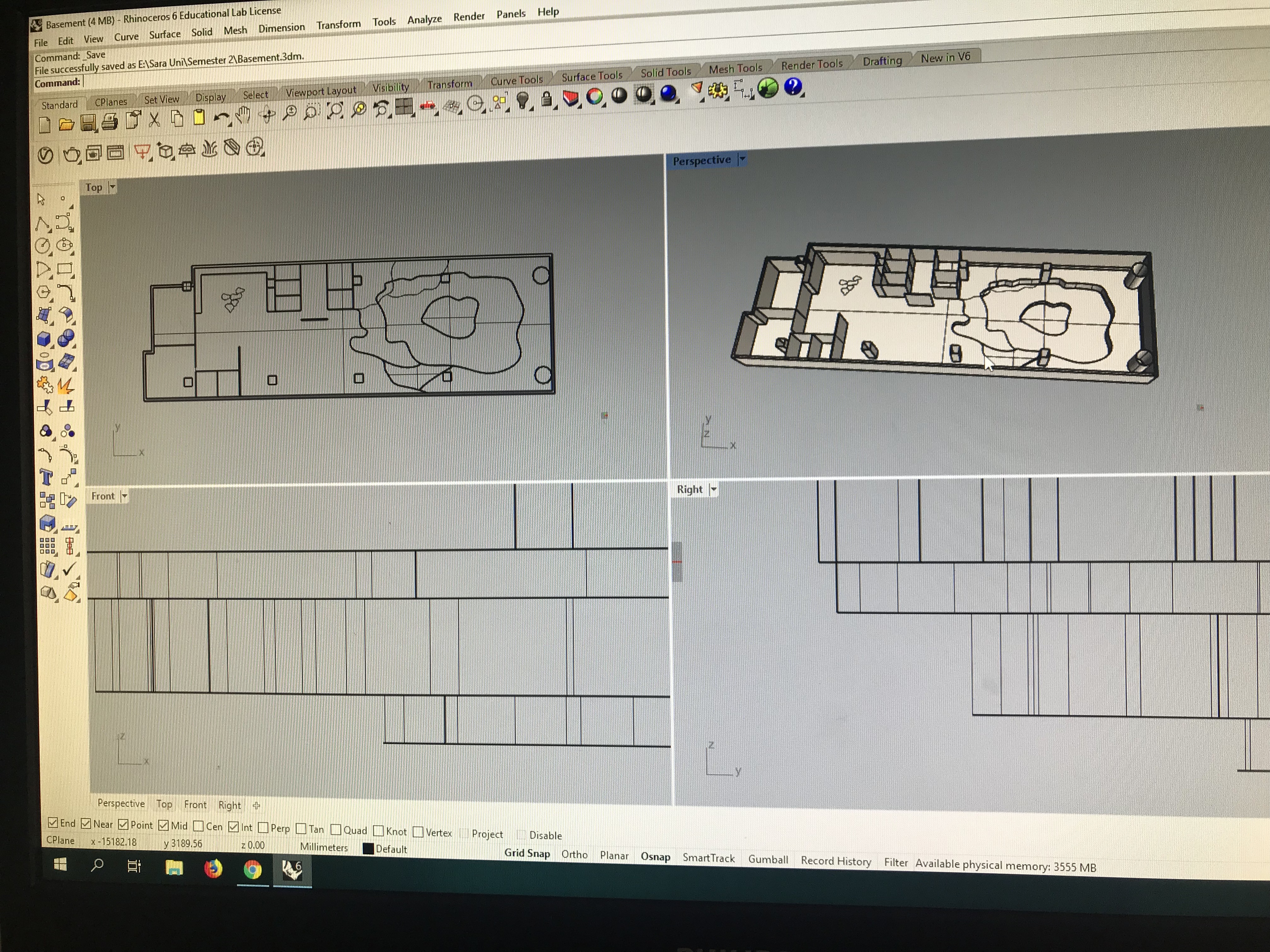
I composed my final design on rhino to be more efficient. This enabled me to easily move sections of my design around the space, see where elements fit best in the space and allowed me to easily test ideas without having to start from scratch if they didn’t work out whilst also building up my digital file.
Designing in Rhino
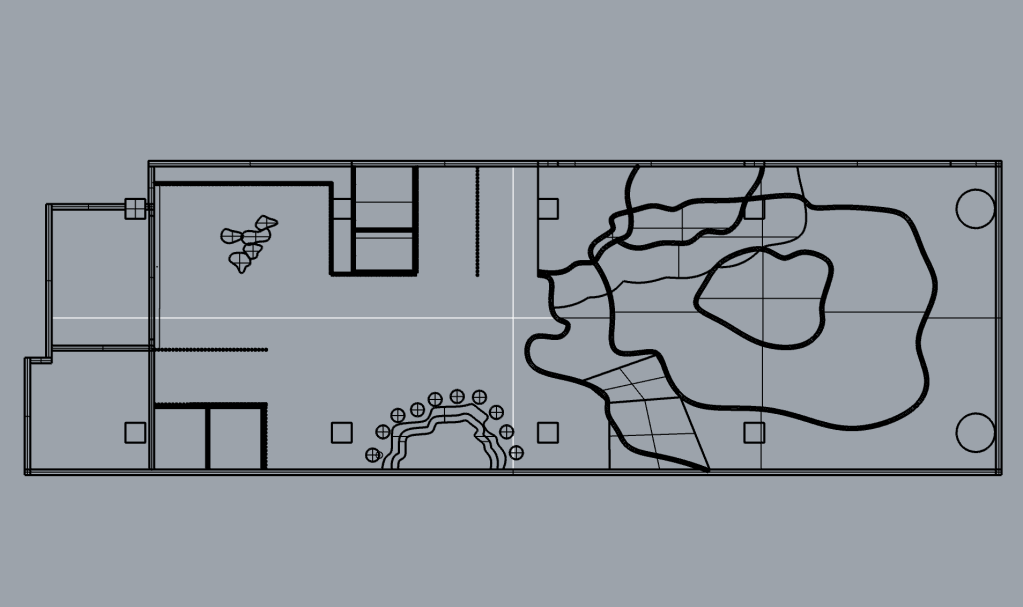
In my final design I changed the entrance point into the space to be more user friendly for anyone with physical disabilities. The entrance is now accessible by elevator and much more open to allow an easy flow into the space.
Due to this change in entrance I had to alter the position of the lockers and bathrooms.
With the bathrooms in their new position I changed their size and didn’t have as many creating a more comfortable space to use. I also included changing rooms opposite the lockers. I also have included some screens in front of both the changing rooms and bathrooms to provide some privacy for users entering and exiting the cubicles.
I changed the shape of the windows continuing the theme of soft natural lines that created the shape of the pools creating a more natural, cavelike, aesthetic. I also applied these soft natural lines to the entrance arch.
I changed the location of the smaller pools to make them more easily accessible and created a walkway around the smaller pools that sits just under the water level to further increase the accessibility to these pools.
I changed the shape of the refreshments bar to a softer natural flowing shape to fit with the theme.
With this design I wanted to enhance and play with the contrasting relationship between sharp lines of the changing rooms, bathrooms, lockers and screens and the soft natural lines of the pools, bar, windows and entrance.
My intention for the basement level of the Dadley buildings was to create a place that feels like you’ve entered into a secret oasis in the heart of the city where you are transported away from the hustle and bustle and immersed in a natural environment.
My design emulates a natural rock pool with staggered levels drawing you deeper into the pool allowing space to sit, swim and dive. The main pool is the temperature of the spring it has come from. Within the pool there are two smaller pools which are heated providing more than one option for the bathers experience.
The open exterior wall brings the outside forest into the space creating spaciousness and enhances the concept of nature bathing allowing the bather to experience the outside whilst still being in an indoor bath. The effect this has on your senses also enhances this concept. You can smell the earth, hear the bird song and see the foliage sway in the wind.
The entrance is subtle and unobtrusive creating a satisfying contrast as you enter into the luxe pool space. Creates the feeling that this is a secret sacred place to escape to.
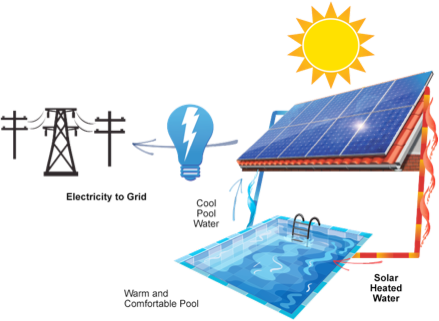
I have implicated the principles of Kotahitanga, Kaitiakitanga and Wairuatanga into my design by heating the pool using solar power installed on the exterior of the building, pumping in water from the Waihorotiu Stream and collecting rainwater from the building to supply the pool and using a natural filtration system of Sphagnum Moss. In the construction of this space everything that can be sourced second hand will be used e.g. recycled wood to build the lockers and refreshments bar, recycled rocks and concrete in the flooring etc.
To the right of the entrance is a refreshments bar that will be stocked with eco friendly refreshments. Any waste that the bar creates will be compostable so can be buried in the forest to feed the plants and biodegrade.
In front of the lockers is a rock formation seating area to rest on when transitioning from the lockers to the pool or vice versa.
I will rely mainly on natural light filtering in through the forest to make the space feel like a natural forest bath.
Everything in the space will be made from natural materials achieving a positive environmental impact and a natural atmosphere making the space a perfect place to escape and relax.
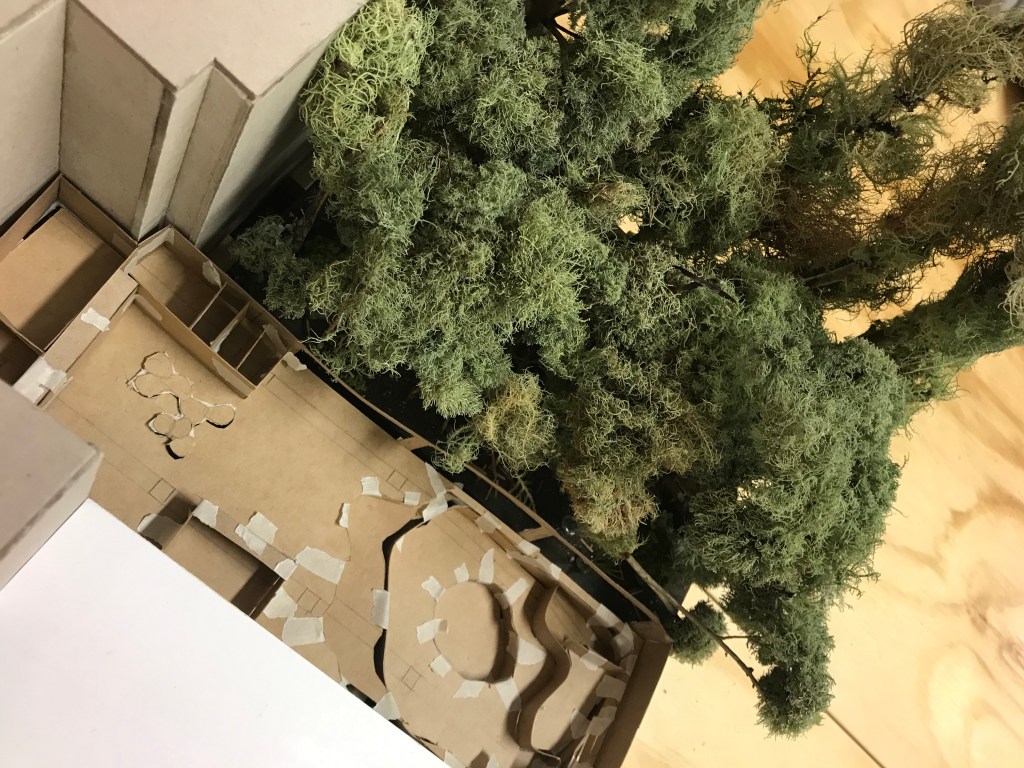
The feedback I got on my presentation was i need to walk the group through my design and be more interactive with my model rather than relying on my notes. I also need a sturdier model so its easy to inspect and pass around and it wont fall apart.
I also found that as I tilted the full model to show the group, the forest slid off the block. We will need to find a way of securing it in place as we present to stop this from happening in the final presentation. Im thinking something along the lines of velcro would do the trick.
I also think I need to speak more to the ideas of my design rather than what can be seen in the model.
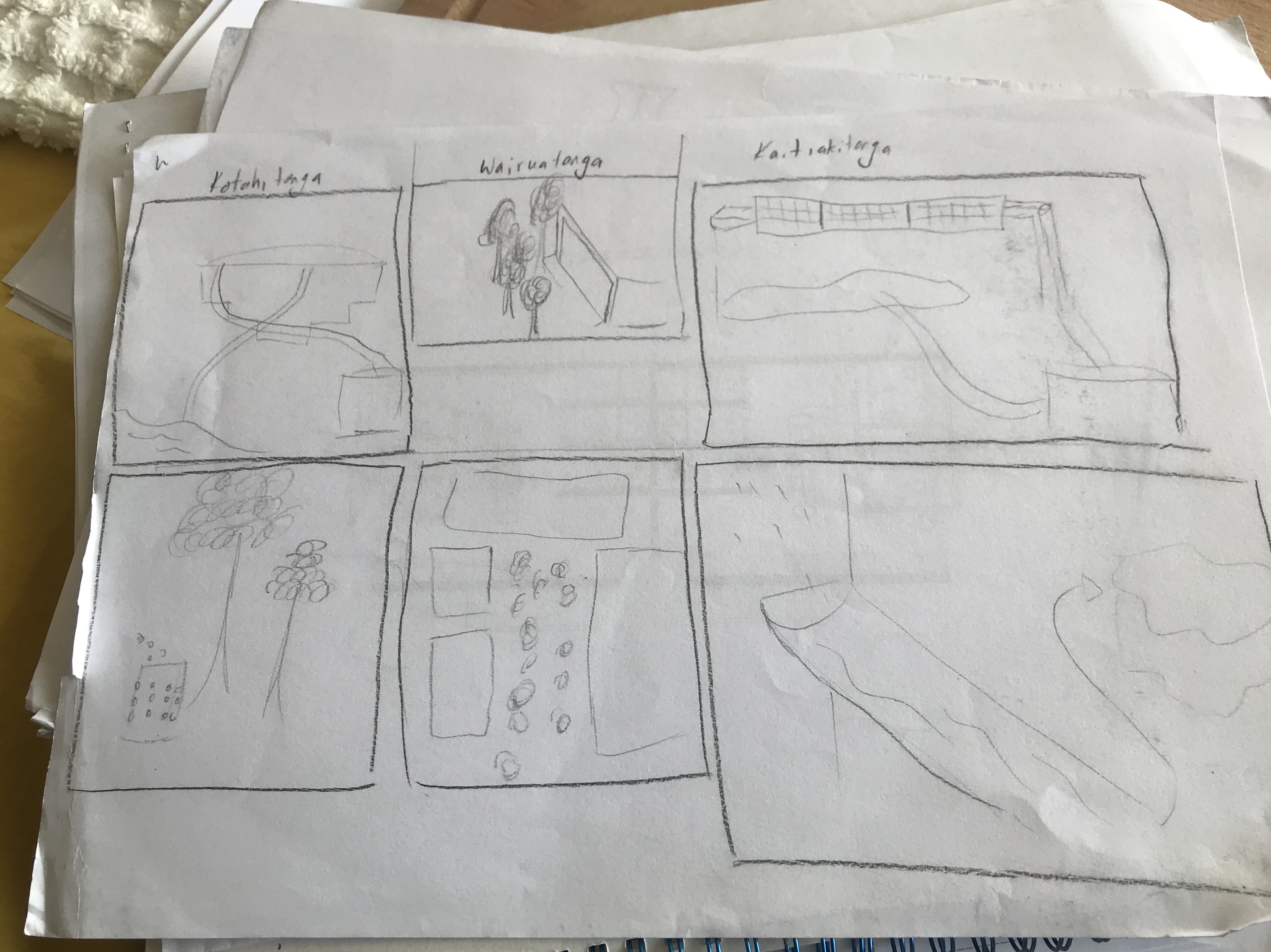
In class we sketched out some drawings of different parts of our design that show, incorporate and align with the different Te Aranga design principles.
This helped me bring some clarity to how I was incorporating these principles and helped develop my thinking around the design aspects also.
I can hear you
making small holes
in the silence
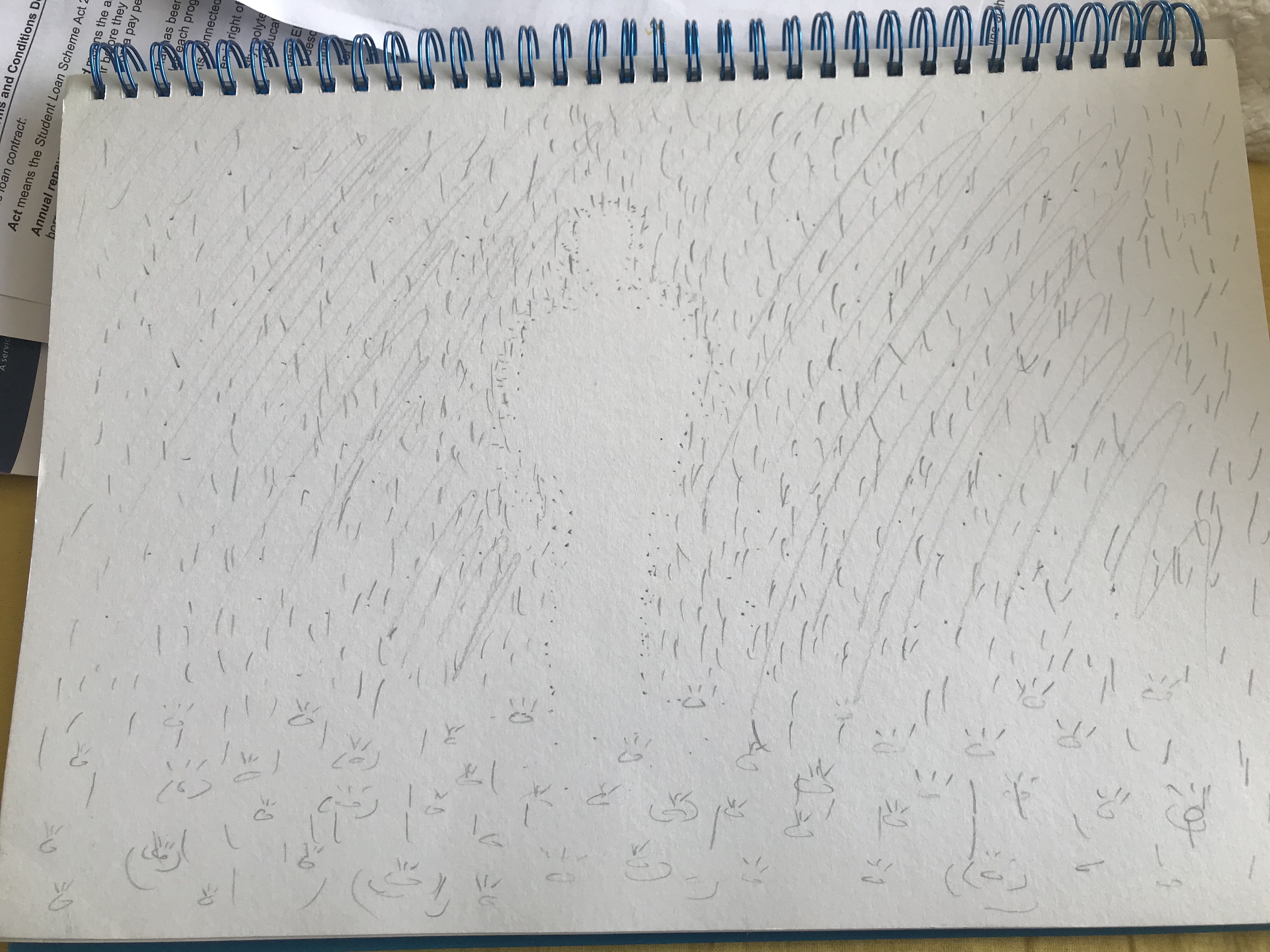
rain
If I were deaf
the pores of my skin
would open to you
and shut
And I
should know you
by the lick of you
if I were blind
the something
special smell of you
when the sun cakes
the ground
the steady
drum-roll sound
you make
when the wind drops
But if I
should not hear
smell or feel or see
you
you would still
define me
disperse me
wash over me
rain
Hone Tuwhare 1922-2008
Tuwhare explores the sensation rain has on all of his senses. I found that this highlights just how emersive an interaction with water can be.
The effect the poem has is that it surrounds you with the sense of rain telling you the sensations to transport you into a downpour. The language he uses is delicate and intimate creating a peaceful and enjoyable experience making your mind pause and rest in the rain.
In my drawing I tried to show the relationship of the rain and the person and show how one effects the other creating a unique experience of being in the rain.
I will definitely take into consideration the highly immersive nature that water can have on a person and carefully consider how my design effects the bathers and their senses.
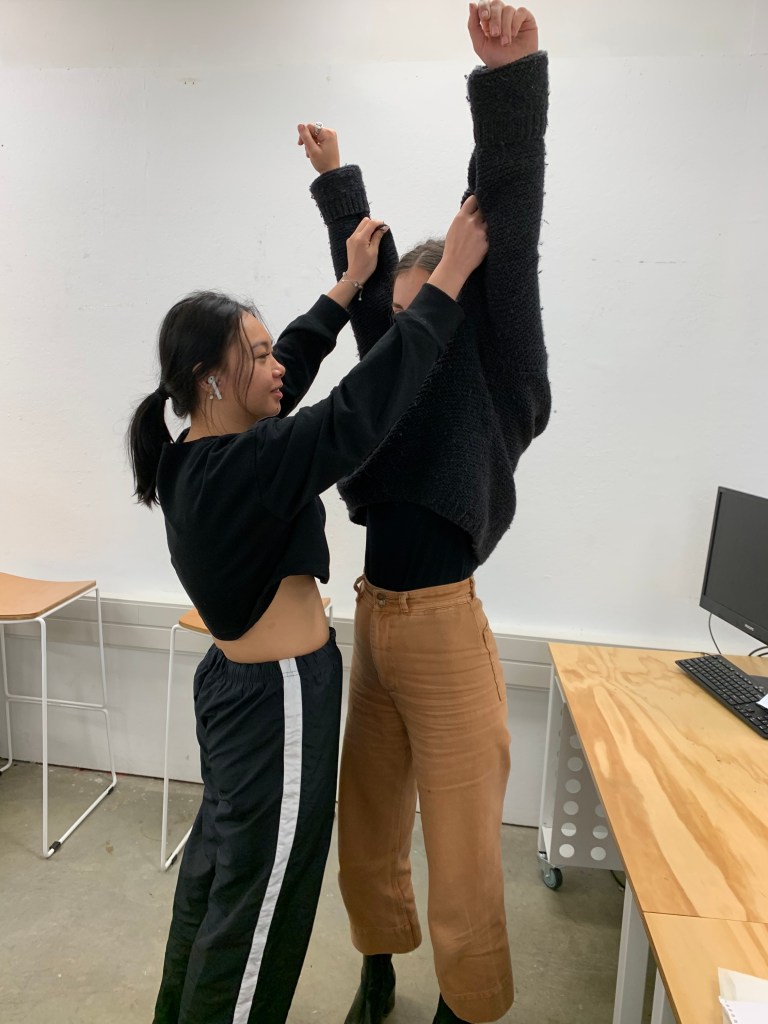
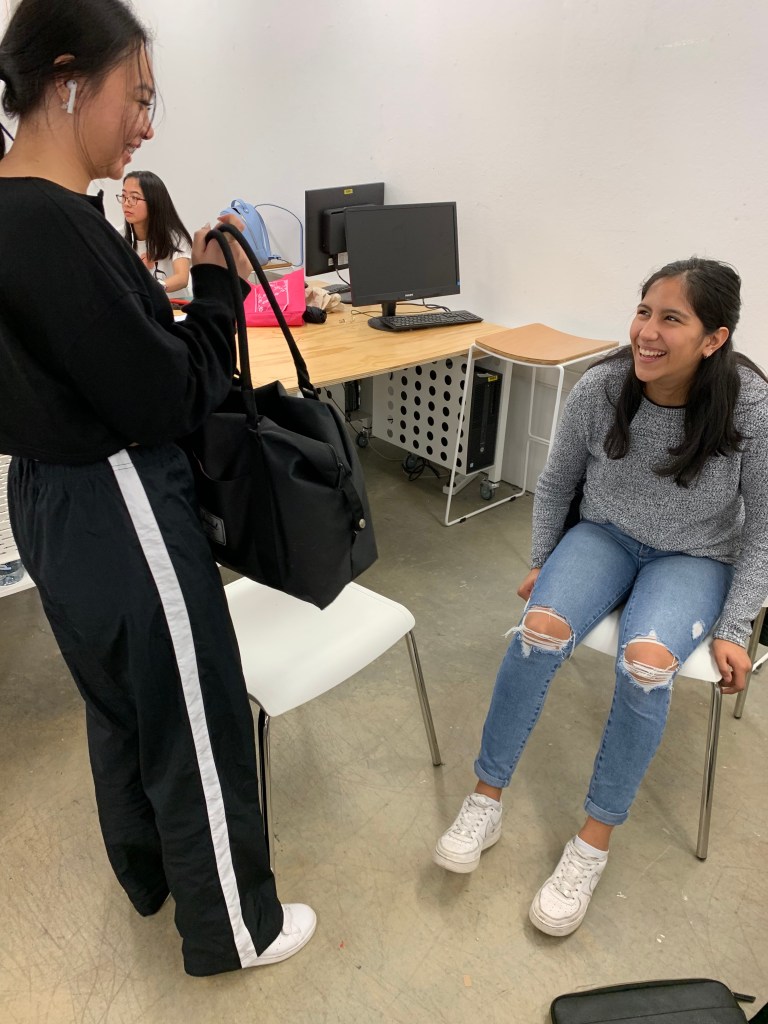
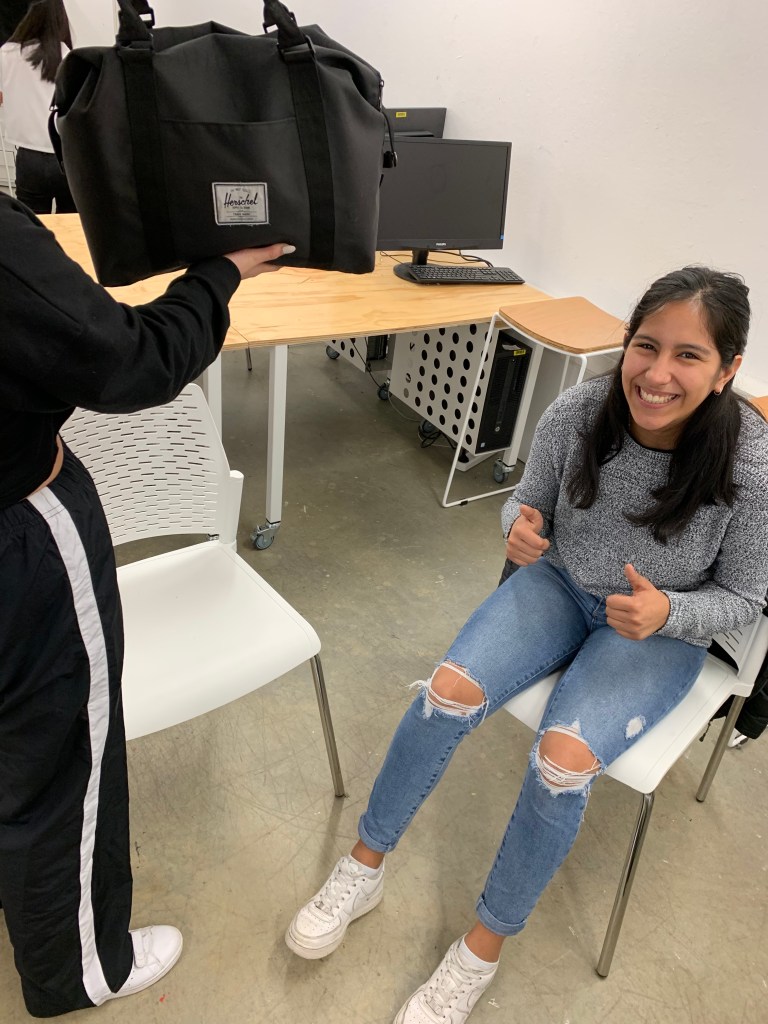
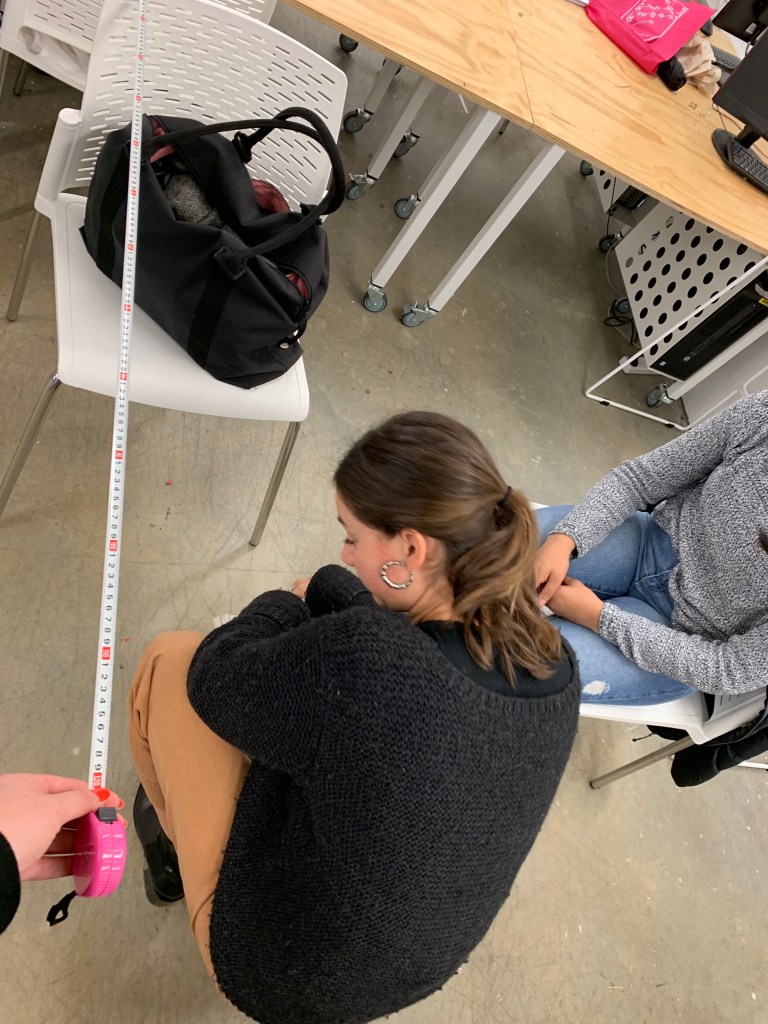
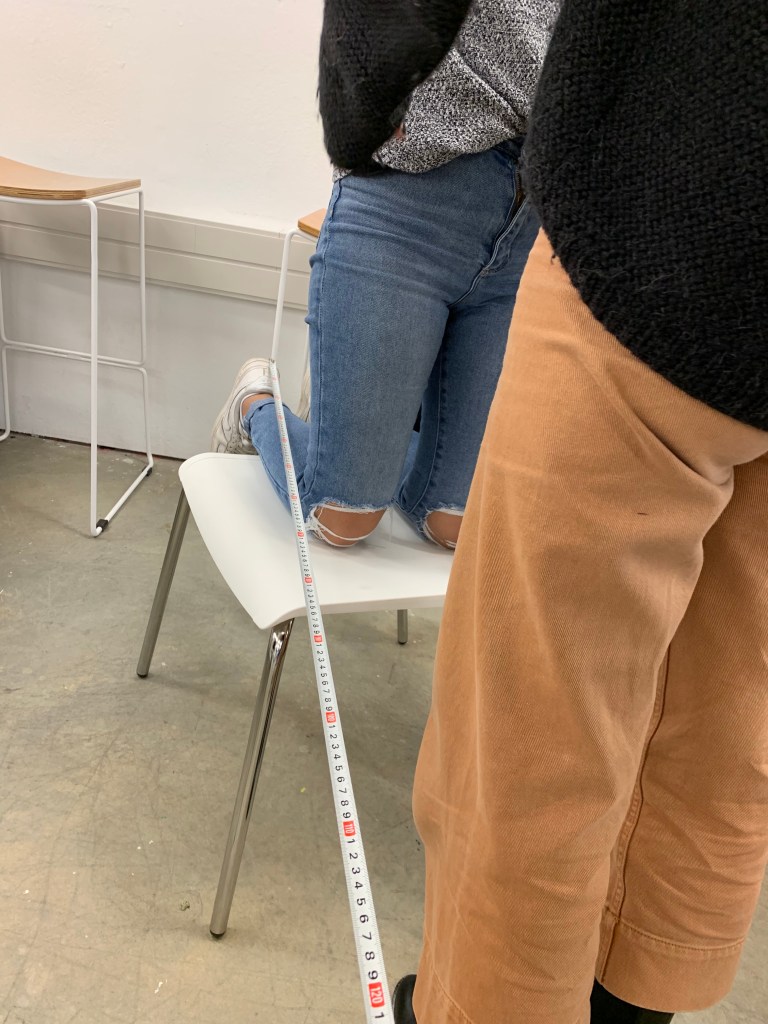
Before designing my second iteration of my model we looked into human ergonomics and understanding space in different scenarios in class. This helped inform my design giving me a better understanding of how much space is needed for people of different physical ability preparing to bathe in my pool.
Daughter assisting disabled Mother
Mother assisting child
Daughter assisting mother with belongings
Daughter assisting Mother with belongings
Mother changing child. Space needed is 120cm squared roughly
Mother changing child on bench – 120cm
Taking into consideration what worked well and what didn’t in my first model I made some changes to my second model.
I made my pool smaller and added two smaller pools within the big pool with different temperatures of 39 degrees in one and 42 degrees in the other. continuing with the natural aesthetic of my pool design I tried to emulate the pink and white terraces with the hottest pool flowing into the cooler ones in a step formation. The main pool will be the natural temperature of the water that gets pumped in estimated to be between 12 degrees and 20 degrees.
I made the bathrooms smaller as I realised it was unnecessary to have such a large space dedicated to the bathrooms considering the amount of people who would be needing the facilities. I now have 3 standard toilets for general use and one accessible toilet to be used by anyone with any physical limitations.
I incorporated lockers and a seating area near to the entrance to provide a space to store your belongings whilst bathing and a spot to rest your belongings on or to sit and get organised.
I designed a refreshments bar near the pool thats nice and long to provide a comfortable space to sit, get a beverage and a snack. With it being close to the pool it allows the bathers to easily transition from the pool without getting water all over the space.
I made the entrance larger to create a more grand threshold moment drawing people in from the concrete jungle outside to the peaceful sanctuary of the bath house inside.
I incorporated a filtration room for the pool pump, mechanics and any gear for pool maintenance to be stored.
Water mechanics and functionality:
Pump and filtration systemSolar heating process for hot pools.
For filtration I wanted a natural alternative to keeping everything clean without using lots of chemicals and found that sphagnum moss can be used as a natural filtration system. poolcareguy.com/eco-friendly-pools/
To develop the design further I will need to incorporate more wheelchair accessibility. My design is currently not easily accessible for wheelchair access and I need to design a way for people with disabilities to get into the pool easily.
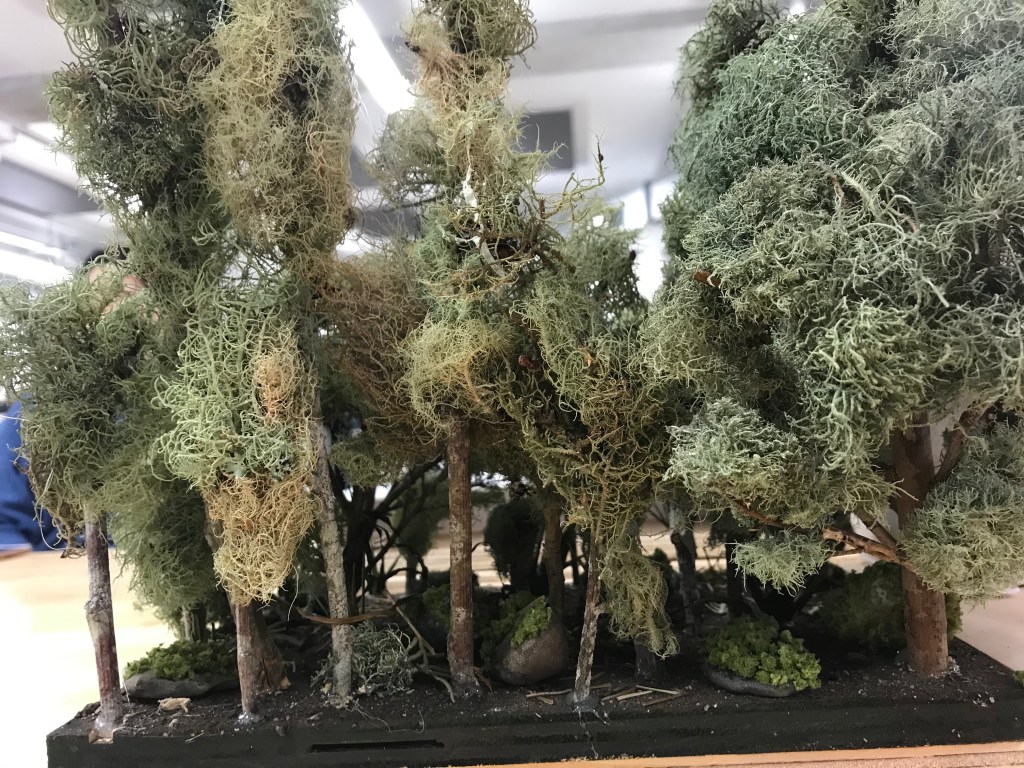
In the construction of the pocket forest Emma, Claudia and I created a variety of miniature trees and plants at different heights to create an understory, canopy and emergent layer for our collective model.
We also covered the ground with soil, boulders and fallen leaves to create a forrest floor.
To construct the trees we used sticks and moss gathered from the garden and varying forms of glue.
To attach the trees to the forest base I had to drill a hole first then fill it with hot glue and put the tree into the hole to create stability in the model as the trees are quite top heavy and wanted to fall over.
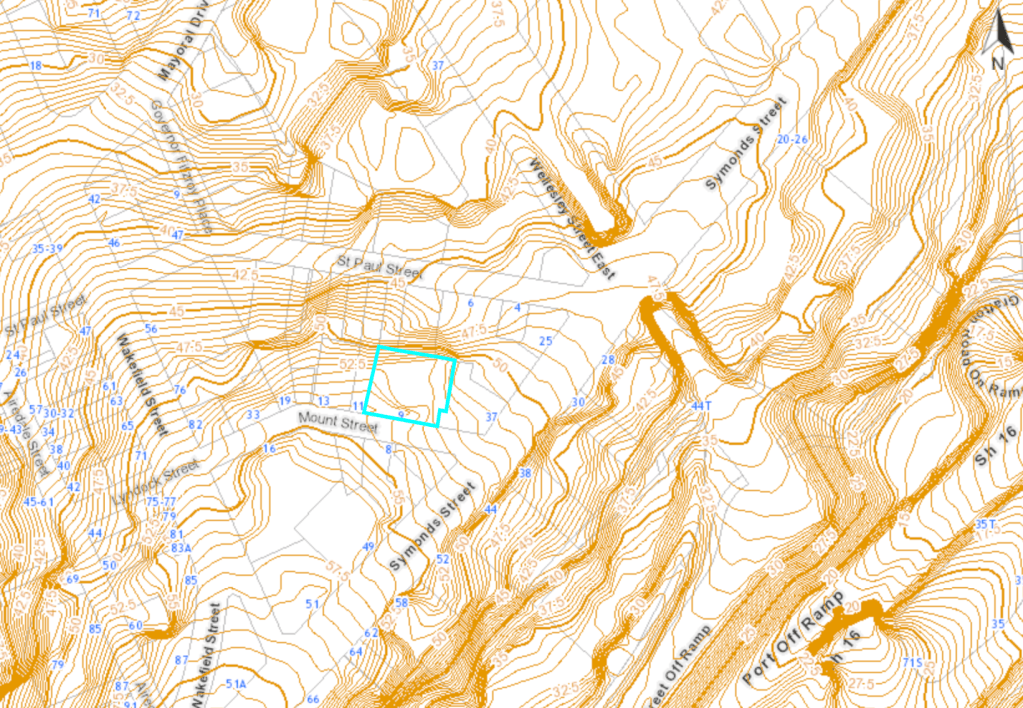
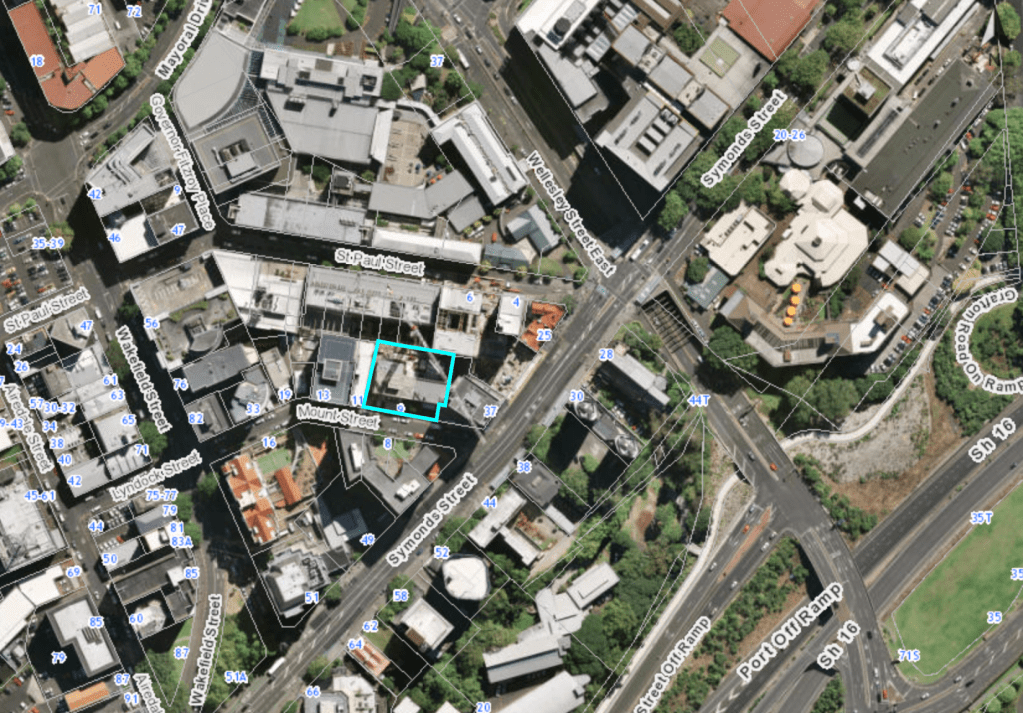
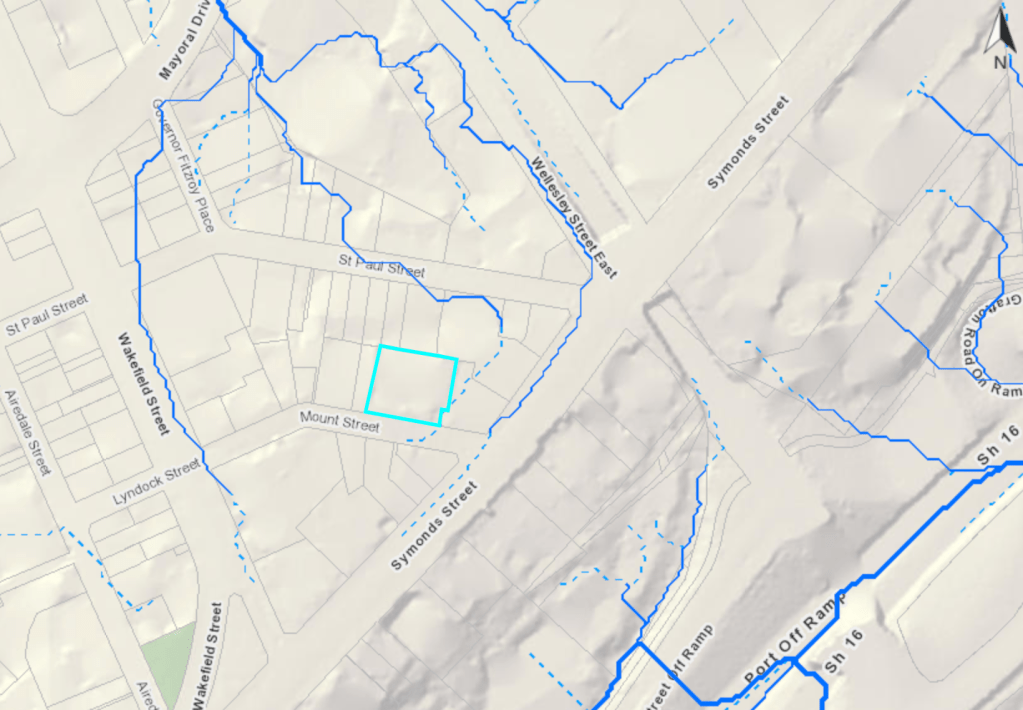
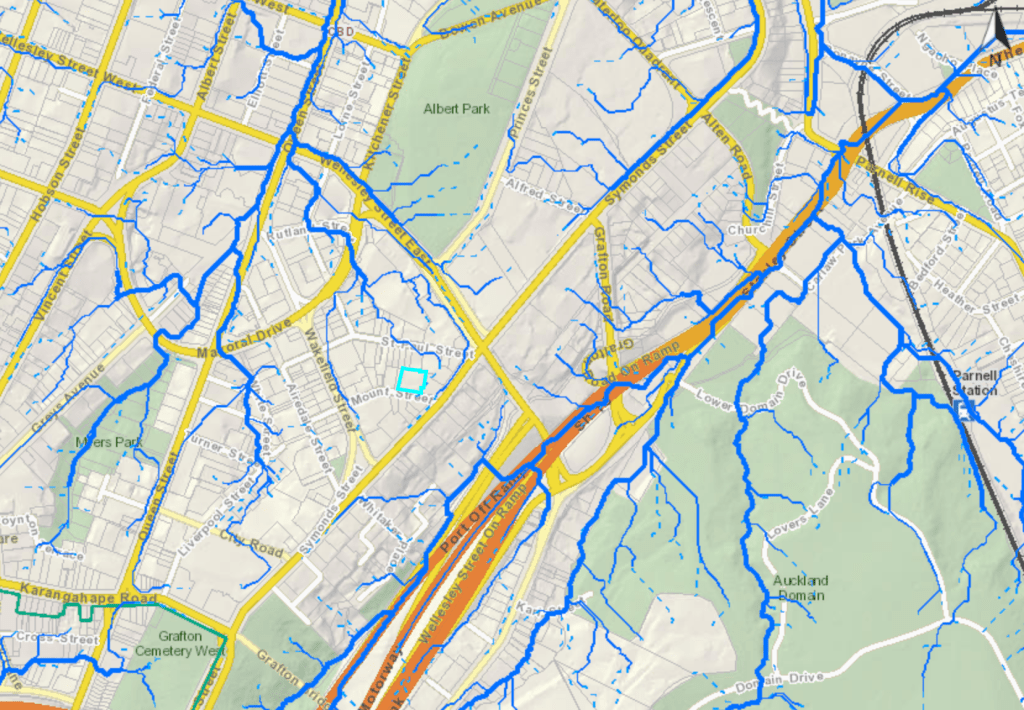
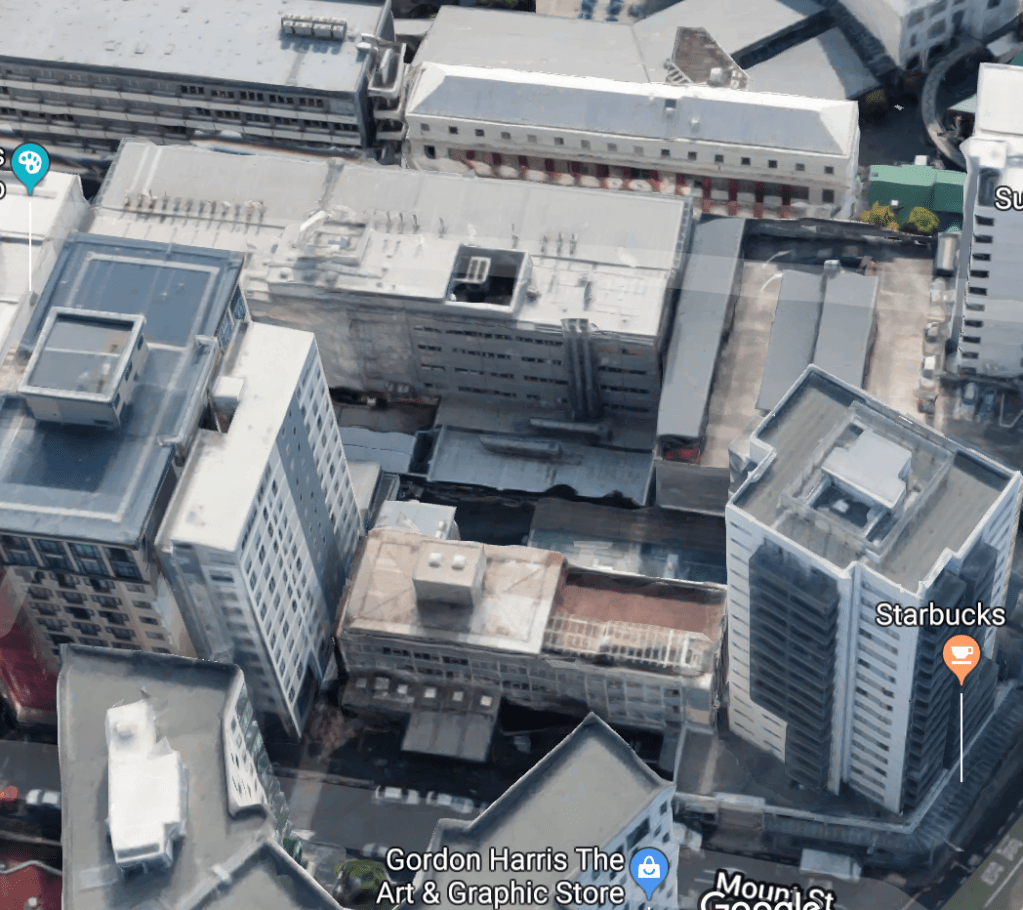
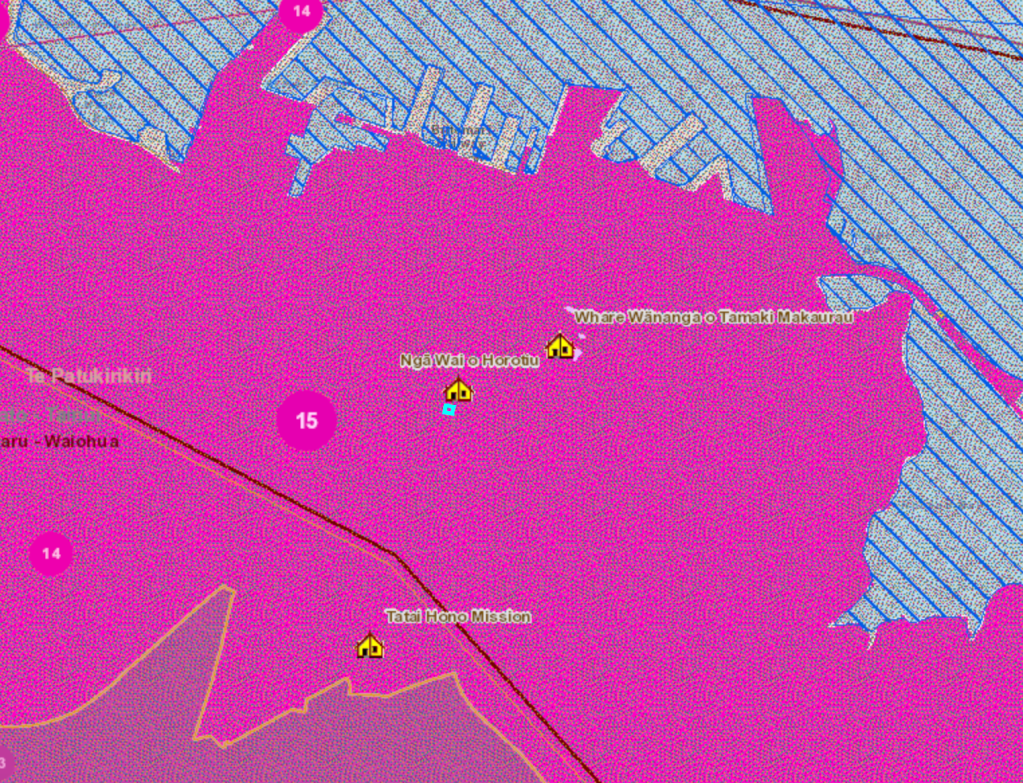
To gain further understanding on the context surrounding the site I looked into the different GIS maps.
Contours
Aerial View
Overland Flow Paths
Wider Context of Overland flow paths
I also looked into the lighting conditions of the site, wind conditions, surrounding buildings and the local iwi to the site.
Surrounding buildings of site
Wind zones
Mana Whenua areas of interest
The building is north facing so is able to get a bit of natural sunlight into the area despite being surrounded by tall buildings especially around mid day. The associated Iwi to the site is Te Patukirkiri and the local Marae is AUT’s Ngā Wai o Horotui.
The Maori influence is important to consider as it is necessary to contact the local Iwi in regards to any cultural aspects of the site and the effects the site has on the environment. The Iwi’s intentions are always to care for, protect and add to their spatial environments through the use of considered design and applying the Te Aranga Principles.
Site Map:
Site Map
My site map explores the contours, water ways, wind and light conditions, local parks and surrounding buildings of my site.
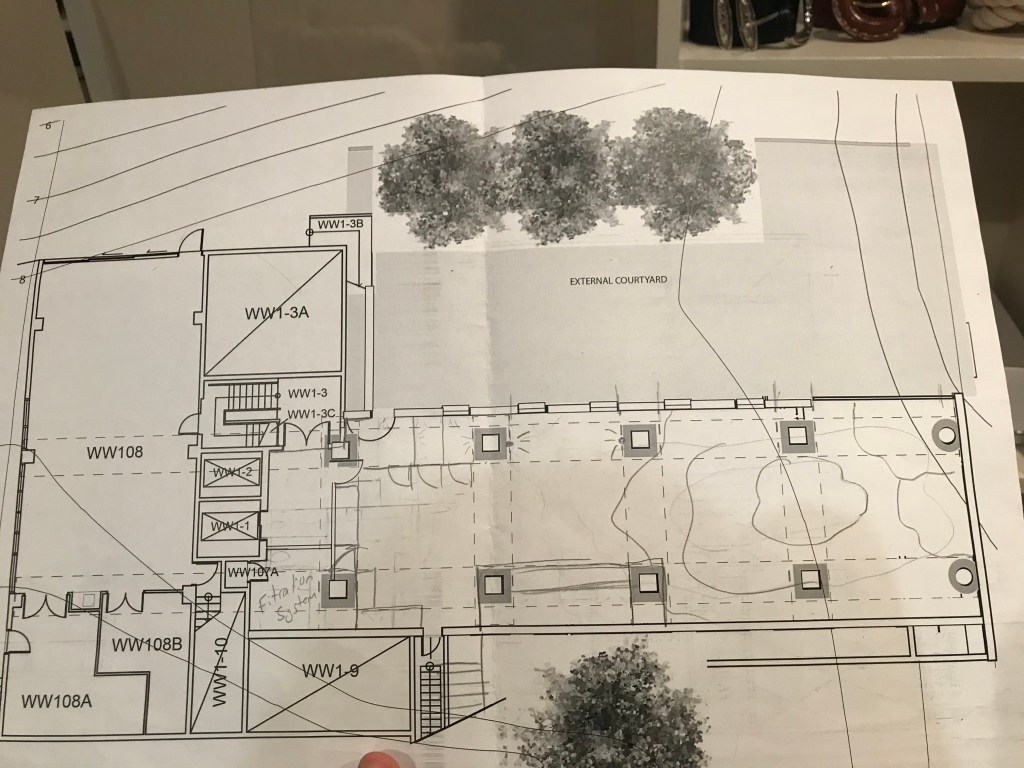
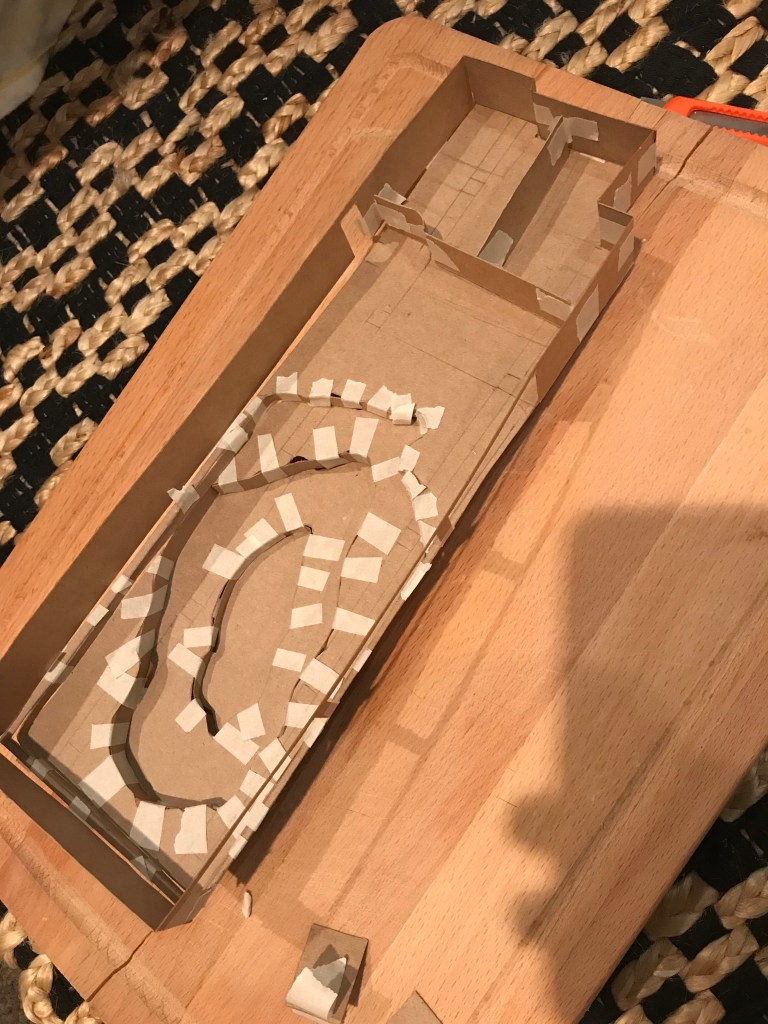
In my first plan I designed a large pool taking over the majority of the floor space with staggered depths as you move deeper into the pool simulating a natural rock pool.
The wall facing the pocket forrest will be open to allow the bathers to experience the forrest as they bathe similar to the traditional Japanese bath houses.
First Iteration of Basement Design Floor Plan.
The pool is my main focal point. Once I had that down I then incorporated the bathrooms.
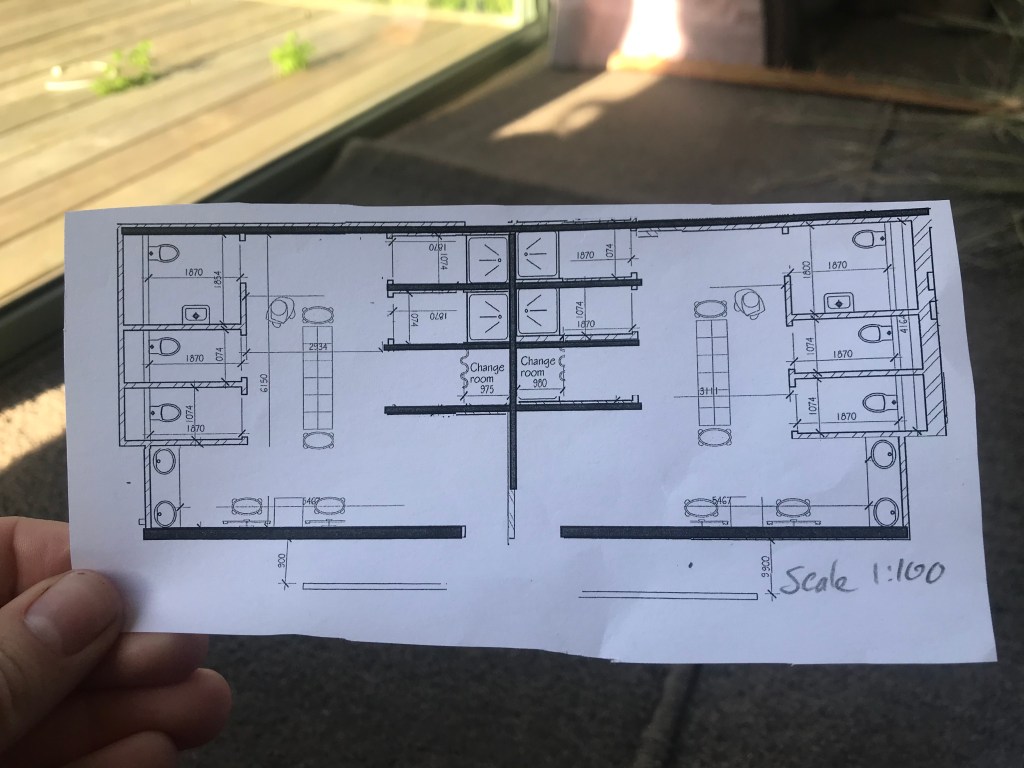
In class we were given a 1:100 scale floor plan of a mens and womans bathroom unit to refer too as a guide for our own bathrooms.
I found the research on doorways (39) and accessible toilets (54) especially helpful.
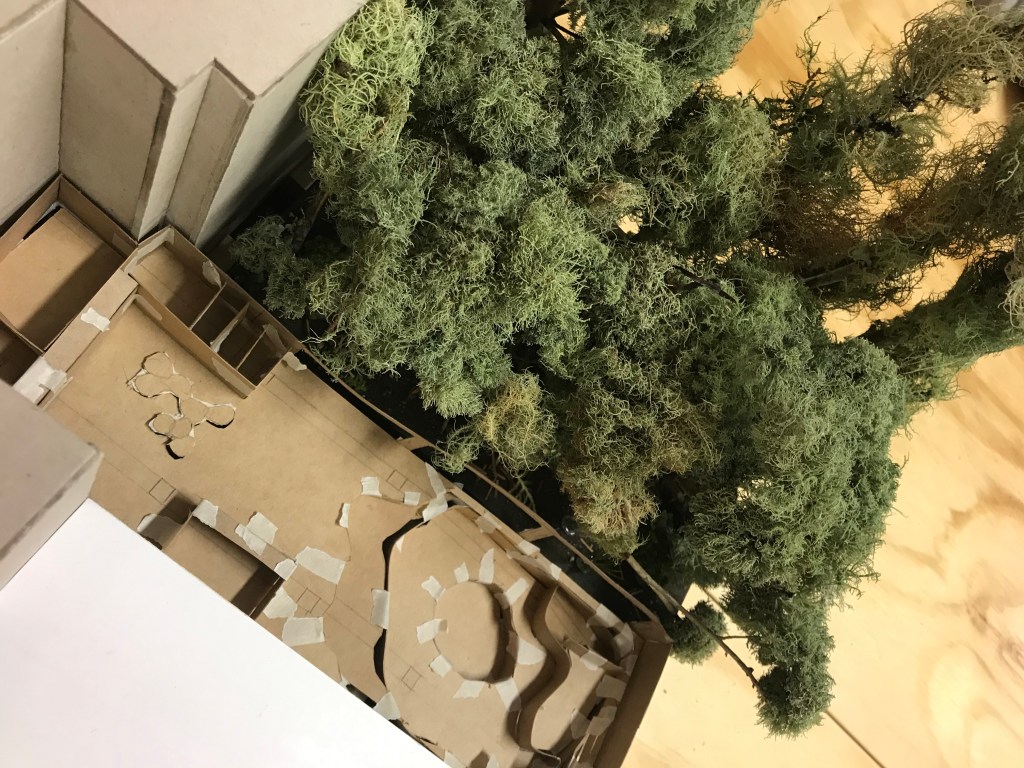
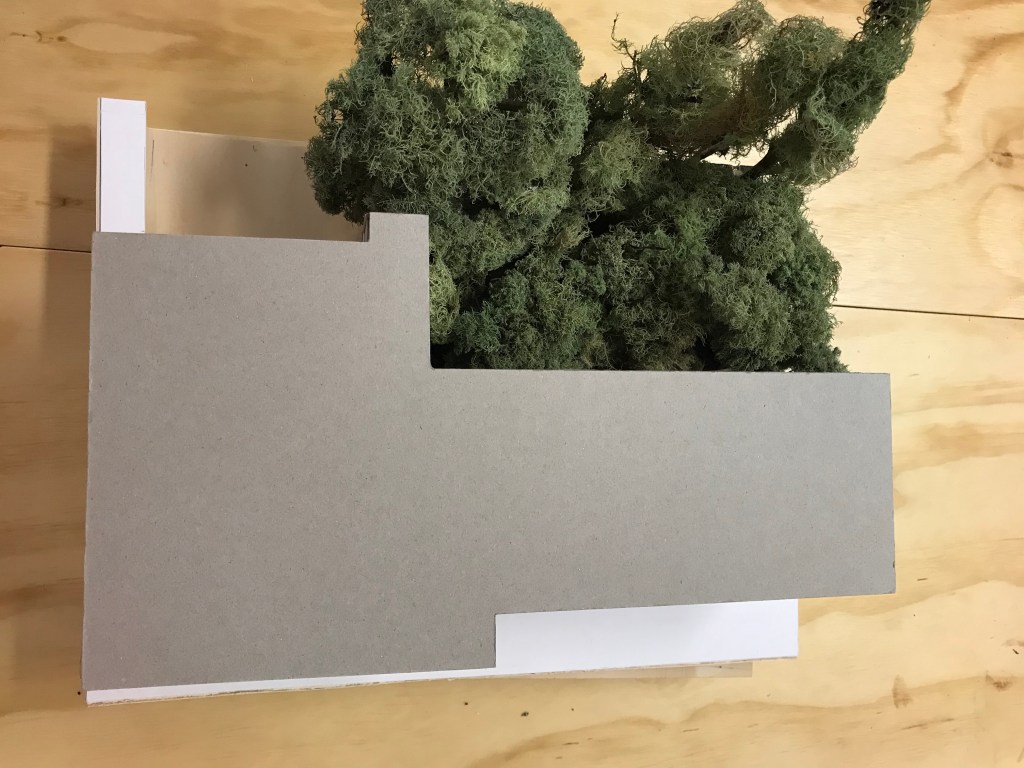
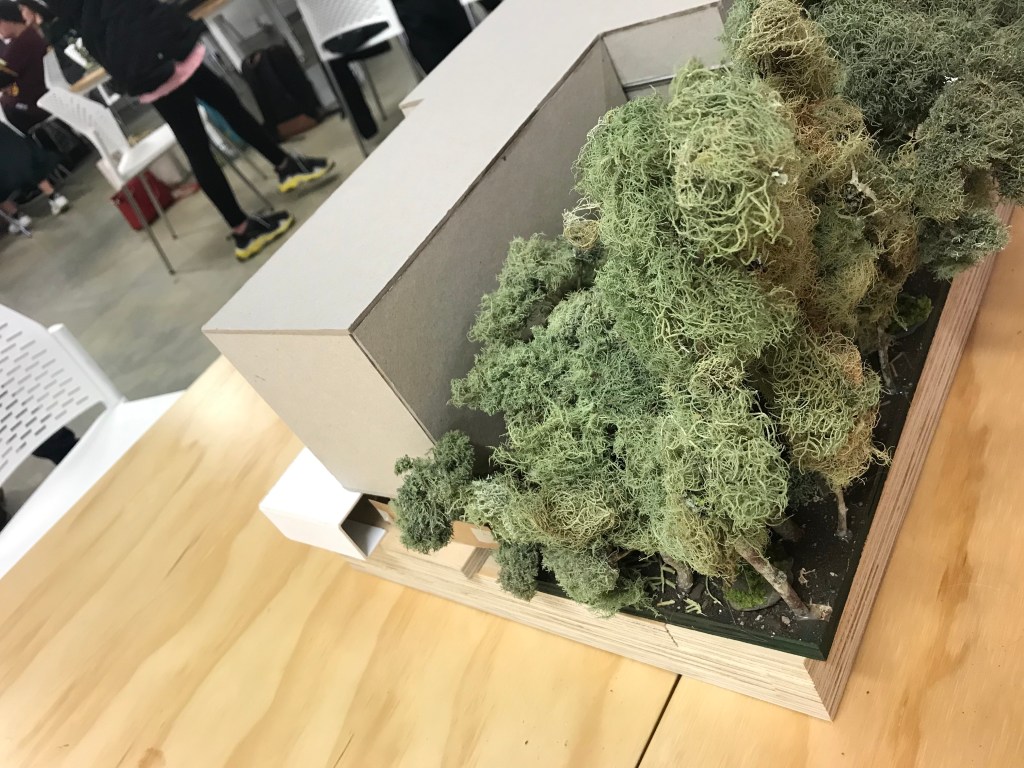
First iteration of model
First iteration of model
First iteration of model
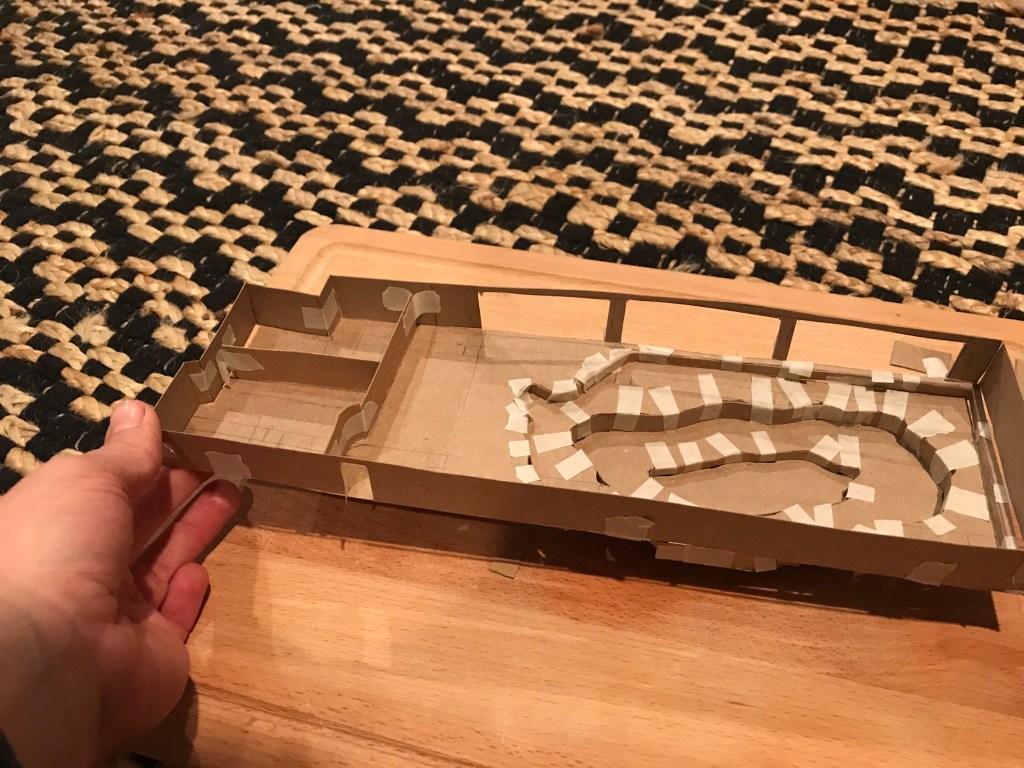
In constructing my first model I found that with having such a large pool it didn’t leave much room for a refreshments area or much space to move around when not in the pool. I felt that it made the space feel a bit cramped. In my next iteration I will design a smaller pool and a smaller bathroom space to allow to space to open up and feel more spacious.
Venetian-style grotto at the Vizcaya Museum designed by Robert Winthrop Chanler.
The natural light bounces off of the creme coloured stone walls allowing the space to feel open and light. I love how the natural coloured stone walls also allows the reflection of the water to to colour the ceiling and walls bringing the art that has been painted a new dynamic. It creates the effect that the water is above you and bellow you a bit like when you’re in a cave pool.
The use of soft lines on the joinery, corners and trimmings gives the space a more natural feel and makes the space feel soft and inviting.
Bunny Williams 18th-century Connecticut estate – by interior designer Bunny Williams
I love the use of the stones as the formation of the pool. It creates a strong feature out of the pool and helps the pool assert its dominance over the space making is clear that this is the star of the show. It also gives the pool an organic feel purely because of the use of natural materials. This also would have been an environmentally friendly option being able sourcing the rock from the local area, reusing available materials.
Ryokan Gyokushoen Arai Hotel – Traditional Ryokan
This traditional Japanese bath house achieves what I would love to incorporate into my design with the indoor outdoor flow. The feeling of bathing in nature whist being in an indoor bath. The lighting conditions of this space is very dim allowing the water to reflect the forest bringing the outside in. it also allows for a stronger sense of privacy and relaxation as our bodies are conditioned to prepare for rest in darker spaces.
Kengo Kuma’s Horai bathhouse
The use of natural wooden beams, clear corrugated roofing and the absence of solid walls provides a natural bathing experience where you’re surrounded by nature whist still being protected from the elements and in a man made, temperature controlled pool. This combines the best of both worlds in a very simplistic way.
Bath House In Karuizawa – Ken Yokogawa Architect Associates
This bath house is a modern take on the traditional Japanese baths. It combines the natural environment with a big open wall (which I love) and natural materials with a modern architectural style using clean lines and a minimalistic interior. Again the lighting conditions are dim and rely more on the natural light coming in from the open wall. The dark polished stone floor also allows some of the natural light to reflect off of its surface carrying the light further into the space. I think this lighting technique is very clever and I will consider working it into my design to allow for more natural light in the space.
One purpose of bathing is for personal hygiene. It is a means of achieving cleanliness by washing away dead skin cells, dirt and soil, and a preventative measure to reduce the incidence and spread of disease. It also reduces body odors.
Bathing may also be practised for religious ritual or therapeutic purposes or as a recreational activity. Bathing may be used to cool or to warm the body of an individual.
Therapeutic use of bathing includes hydrotherapy, healing, rehabilitation from injury or addiction, and relaxation.
Benefits of swimming in cold water:
It helps you sleep better – We’ve all seen athletes plunge into ice baths to relieve muscle soreness. This is because our parasympathetic systems, responsible for rest and repair, are stimulated by cold water. Cold water swimmers often speak about being able to sleep particularly well after a quick dip.
It gets your blood pumping and improves circulation – A 2012 study of 43 older men and women found that those who swam a few times a week lowered their systolic blood pressure. This is because when we are cold, blood rushes to our organs – urging our hearts to work a little bit harder. A regular dip will help flush circulation and pump blood through capillaries, veins and arteries.
It’s an immune booster – Diving into ice cold water can cause quite a shock to the system… Particularly the immune system. A Czech study found a significant increase in the white blood cell counts of subjects immersed in cold water for one hour. This is because the immune system feels as though it’s being attacked and is startled into action.
It enhances happiness– Swimmers often report a “high” after delving into cold water, and many people take regular dips to fend off depression. This addictive sense of wellbeing and happiness is all down to endorphins. The body’s natural painkillers – these happy hormones kick in when you jump in to take the sting away from the cold. The cold also triggers the release of dopamine and serotonin – which help keep us chirpy.
It’s great for the skin – Immersing yourself in cold water has an exfoliant effect on skin – helping it appear smoother. The cold also improves circulation which helps combat cellulite and flush out impurities. What’s more – when we’re cold, blood rushes to the skins surface creating a glowy effect.
It increases your metabolism – Swimming in itself is great exercise, but delving into cold water helps to burn extra calories. This is because your body has to work twice as hard to keep you warm and get you back to your normal temperature. Your metabolism can increase by up to 550% of its resting level.
It has a calming effect – Swimming creates the same relaxation responses as yoga and is highly conducive to meditation. Many outdoor swimmers speak about the calming effect the exercise has on them, which lasts all day.
It increases alertness – If you struggle to stay awake in the morning, a plunge into cold water ought to help you out. The shock of cold will create a surge of adrenaline making you feel alert and energised.
Hot springs contain different materials like calcium and sodium bicarbonate. With that being said, when you rest in the water you absorb the minerals. According to livestrong.com, when you soak up the minerals “your hydrostatic pressure rises”. Your blood starts pumping and you get to feeling like you’re working out. Blood circulation helps your body feel not so stiff and tired as it would if you were lying in bed all day.
Relieves stress and calms you down.
While you sit in the pool, the heat deeply relaxes your muscles, resulting in the release of body tension. By relaxing and de-stressing, your body is able to fall asleep faster. De-stressing in general is very beneficial to your health. It takes the tension out of your body and therefore allows your mind to relax and get your blood flowing again and your heart beating. In turn, you can make better decisions with a clear mind and you can, even if it is just for a minute, forget your problems.
Hot springs are great for people with chronic pain.
According to leaf.tv, who cited Dr. Andrew Weil, a hot spring can help with joint pain, muscle fatigue, tissue damage, and others. The Chinese and Japanese have evidently been using hot springs to cure these pains for thousands of years. The heat loosens your skin from your bones and the muscles and helps you move freer.
Skin conditions can also be helped with hot springs.
In natural hot springs, there is something called silica that can actually really help your skin. If you have eczema or psoriasis, the sulfur in the water really helps to heal it. Sulfur is used to make collagen, which keeps your skin healthy and smooth. Sulfur also helps with dry scalp, arthritis, and other possible medical conditions.
The heat helps with nasal congestion and digestion problems.
The heat and steam rises to your sinuses, clearing out the pathway. The saltwater is what helps the digestion tract. Something else along these same lines, hot springs can help exercise your autonomic nervous system as well as stabilise your endocrine system. Detoxification of oils and dead cells can occur through you sweating it all out.
Nature can be a very strong mood enhancer, helping many people across the globe to feel happier every day. In one study, published in the science journal PLOS One, those that interacted with nature routinely showed a significant increase in their own happiness. This effect lasted not only for the entire duration of their study, but for months after the study was finished.
Makes you healthier
Being out in nature also makes you healthier, in a number of different ways. For example, being out in nature exposes you to phytoncides, airborne chemicals that plants produce to protect themselves from insects. However, by breathing in these chemicals, you actually increase the activity of certain types of tumour and virus-killing white blood cells.
Reduces stress
Being outside amongst nature can also reduce the amount of stress you feel. One study found that people who were exposed to a forest environment had lower levels of cortisol – a hormone that is often used as a marker for stress. The conclusion of that study? “Stressful states can be relieved by forest therapy”
Increases focus
Nature is also widely known to help improve focus. Focus is something that is severely lacking for many of us, as our lives get increasingly busier with jobs, school and family life. Mental fatigue is real, but one thing that can help you to focus more is exposing yourself to restorative environments. Restorative environments were found to have increased the attention span of people who were exposed to them over those that weren’t.
Enhances cognitive function
Spending time in the great outdoors can also have a restorative effect on the human psyche. People with mental health issues, such as depression, were found to have reported an increase in their own mood. Other cognitive benefits of being outside in nature include increased working memory performance, as well as decreased anxiety and rumination.
The water temperature shouldn’t too far exceed your own body temperature. While a hot bath feels great, a warm bath is better for your skin and immune system. Add oils like rose, lavender, calendula, aloe, oil, or coconut and also oatmeal for your skin. Epsom salt is great for your muscles and reducing any chances of infection. Keep part of your body, like your face, out of the water to prevent over-heating. Soak for 10-15 minutes, breathe, relax, enjoy. – https://www.townandcountrymag.com/style/beauty-products/a18673205/hot-baths-benefits/












 Spatial Fabrication